Buying a rug at auction starts with a total budget, not just a maximum bid. Your final cost can include the hammer price, buyer’s premium, applicable tax, shipping and insurance. At HeritageBids, the buyer’s premium for purchases made directly through our platform is 15% of the hammer price. That means a $1,000 winning bid becomes $1,150 before tax, shipping and insurance.
This guide explains five costs to check, shows the arithmetic with a worked example, and helps you set a bidding limit before the auction begins. It applies to antique, vintage and modern rugs; the particular lot’s terms and shipping arrangements should always guide your decision.
Buying a rug at auction: 5 costs to check
1. Hammer price: the accepted winning bid
The hammer price is the amount at which the auctioneer sells the lot. It does not include the buyer’s premium or delivery costs. A starting bid is the opening amount at which bidding may begin; it is not a prediction of what the rug will sell for.
The low and high estimates are a separate pre-sale opinion of the likely hammer price. A rug may sell below, within or above that range. Neither the starting bid nor the estimate should be treated as your final invoice amount. For the bidding process itself, see our guide to buying at HeritageBids.
2. Buyer’s premium: a percentage added to the hammer
The buyer’s premium is paid by the buyer in addition to the accepted bid. For direct HeritageBids purchases, calculate it by multiplying the hammer price by 0.15. A $500 hammer price produces a $75 premium; a $1,000 hammer price produces a $150 premium.
If you participate through LiveAuctioneers or another marketplace, check the premium and any applicable fees displayed for that sale on that platform. Do not assume that the direct HeritageBids rate applies there, and do not automatically add both platforms’ premiums together. Use the terms for the route through which you place your bid.
3. Applicable tax: check the delivery details
Allow for any applicable sales tax when planning your purchase. Provide the correct delivery address and review the tax amount on your invoice. Do not assume that tax is calculated on the hammer price alone: the taxable amount and treatment of other charges can vary.
If you believe a purchase qualifies for an exemption, ask what documentation is required before bidding. For international deliveries, also check potential import duties, customs charges and destination taxes. These may be separate from the auction invoice. This guide does not calculate a tax rate for your particular purchase.
4. Shipping: price the packed rug, not just its floor size
Rug shipping depends on the collection location, destination, packed dimensions, weight and service. A large carpet with a modest hammer price can still be costly to transport. Two rugs of similar floor dimensions can produce different shipping quotes because their thickness, weight and packing requirements differ.
Carriers may also consider how much space the package occupies. UPS explains dimensional weight and package measurements, which helps explain why a bulky package can cost more than its weight alone suggests. A carrier calculator is useful only when the packed measurements and service details are accurate.
5. Insurance: confirm what the quote includes
Buyers pay shipping and insurance at HeritageBids. Ask whether insurance is already included in the shipping figure so you do not count it twice. Also confirm the insured amount and how to report a delivery problem. Do not assume that a carrier’s standard included protection is the same as the coverage arranged for your purchase.
For budgeting, put shipping and insurance on separate lines unless you receive a combined quote. Use the combined amount once when calculating the total.
Buying a rug at auction: a complete cost example
The following illustration uses a $1,000 hammer price and the 15% direct HeritageBids buyer’s premium. The shipping, insurance and tax figures are hypothetical budgeting amounts, not a quote, tax calculation or advertised shipping rate.
| Cost | Calculation or assumption | Amount |
|---|---|---|
| Hammer price | Accepted winning bid | $1,000 |
| Buyer’s premium | $1,000 × 15% | $150 |
| Shipping | Hypothetical quote | $140 |
| Insurance | Hypothetical separate charge | $20 |
| Tax allowance | Illustrative amount only | $100 |
| Total budget | Sum of the five costs | $1,410 |
In this example, the total is $410 above the winning bid. That difference is why a $1,000 spending limit should not become a $1,000 maximum bid without checking the other charges first. Replace every assumed amount with information for your lot and delivery address.
How to calculate your maximum bid
A practical approach to buying a rug at auction is to work backward from what you are comfortable spending. First set your overall budget. Then reserve money for delivery, insurance, applicable tax and any separately planned work. The remainder must cover both the hammer price and buyer’s premium.
For a sale with a flat premium, this planning formula is useful:
Maximum hammer bid = (total budget − allowances for other costs) ÷ (1 + premium rate).
Suppose your total budget is $1,500 and you set aside $350 for the other costs. At a 15% premium, the calculation is ($1,500 − $350) ÷ 1.15 = $1,000. That is your maximum hammer bid under those assumptions, not a guaranteed final invoice.
Tax or insurance may change with the winning price, so recheck your allowances against the intended bid. Round down to a permitted bidding increment rather than exceeding your budget to reach the next increment. For an absentee bid, check that the maximum you enter represents the hammer bid and leaves room for all additional charges.
If you are considering several lots, allocate a budget to each and consider the possibility of winning all of them. Multiple active bids can create a larger commitment than you intended. Do not count on losing one lot to make another affordable.
What to ask before agreeing to rug shipping
HeritageBids uses virtual consignment: rugs remain with their owners until sold and ship from the consignor’s location. A rug should not be assumed to ship from New York simply because HeritageBids has a New York business address.
Before buying a rug at auction, send the lot number, sale details and delivery postcode to HeritageBids. Ask for a shipping estimate and confirm:
- The rug’s collection city and country.
- Whether the quote includes packing and insurance.
- The service level and any delivery restrictions.
- Whether local collection is possible for that particular lot.
- Whether multiple purchases can be combined, if they are at the same location.
- Which charges could change once the rug is packed.
A combined shipment is not always possible when lots belong to different consignors. Similarly, local collection must be arranged for the actual lot location; do not make travel plans until the arrangements are confirmed.
For an international purchase, ask about export and import requirements before committing. A delivery estimate is not a guarantee of customs clearance time. Keep a copy of the agreed shipping information alongside the lot details.
Check condition before finalizing your budget
Cleaning, a suitable rug pad or specialist repair may be separate costs after purchase. They are not automatically part of an auction invoice, but they can affect what a particular rug will cost you to use. Ask for an assessment and price for any work you consider necessary rather than assuming every rug needs the same treatment.
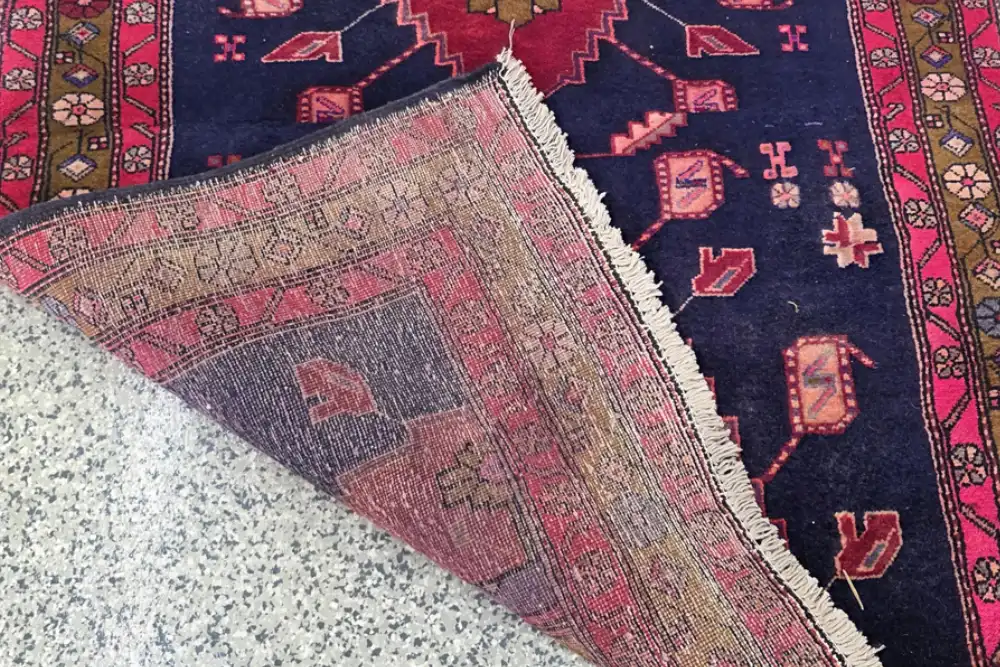
Use our rug condition report checklist to review pile, ends, edges, repairs and other concerns. The catalog description and the separate condition report serve different purposes. Request the report and read it alongside the photographs before setting your limit.
Price is also only one part of choosing a rug. Dimensions, design, materials and attribution help explain why two apparently similar rugs may attract different bids. Our guide to what makes a Persian rug valuable discusses those factors without treating a regional name as a fixed price.
Before bidding, have these five things ready:
- Your lot number and the correct rug dimensions.
- The condition report and any answers to follow-up questions.
- The premium for your chosen bidding platform.
- A delivery and insurance allowance, plus applicable tax.
- Your maximum hammer bid, written down before the live sale.
Payment timing after the auction
Payment for HeritageBids purchases is due within 72 hours after the auction ends. Plan your payment method in advance; the deadline is measured from the end of the auction, not from the date you first open the invoice email.
Review the invoice for the lot, hammer price, premium and other charges. Ask promptly about anything you do not understand. HeritageBids coordinates shipment after payment, and tracking details are provided when the lot ships. Check the current Terms of Sale and the terms displayed for your auction before bidding.
Frequently asked questions about buying a rug at auction
Does the estimate include the buyer’s premium?
At HeritageBids, the estimate is a pre-sale opinion of the likely hammer price. Budget separately for buyer’s premium, applicable tax, shipping and insurance.
What does a $500 winning bid cost at HeritageBids?
With the 15% direct buyer’s premium, a $500 hammer price becomes $575 before applicable tax, shipping and insurance. Your final total depends on those additional charges.
Does no reserve mean no additional fees?
No. No reserve refers to the sale’s minimum-price arrangement, not its fees. A buyer still owes the applicable premium and other charges. Check the published starting bid for each lot.
Can I get a shipping estimate before bidding?
Contact HeritageBids with the lot number and delivery postcode to request an estimate. Ask which amounts are confirmed and which depend on final packing. If shipping determines whether the purchase fits your budget, resolve that question before you bid.
Should I use my full budget as an absentee bid?
No. Leave room for the buyer’s premium and other costs first. Your maximum bid should reflect the amount available for the hammer price after those allowances.
Ready to compare rugs? Browse the HeritageBids auction catalogs, shortlist suitable lots, and calculate the delivered cost of each before choosing your bidding limit.