The Origins of Art Deco: Paris 1925 and the Birth of a Movement
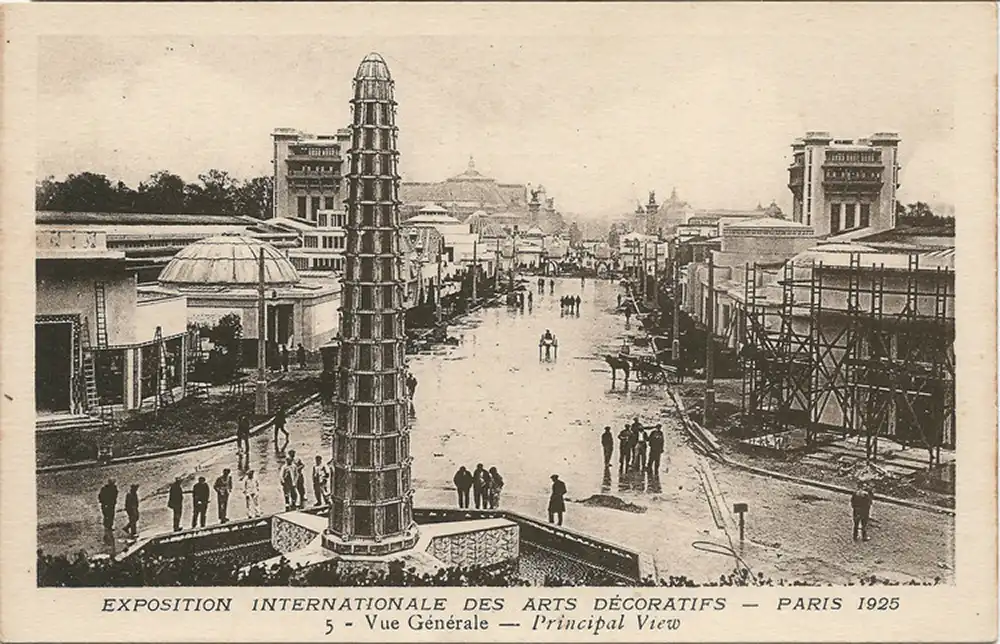
The name itself comes from a single event. In the summer of 1925, Paris hosted the Exposition Internationale des Arts Décoratifs et Industriels Modernes, a sprawling showcase of design that drew millions of visitors to pavilions along the Seine. The movement we now call Art Deco took its name from that exhibition, though the term was not widely used until decades later when collectors and historians looked back and recognized that something coherent had been on display.
The style was born from a specific mood. Europe had emerged from the First World War exhausted but hungry for optimism, and the wealthy classes wanted objects that signaled progress, confidence, and modern luxury. Art Deco answered that appetite. It rejected the flowing, organic lines of Art Nouveau, the style that had dominated the previous generation, and replaced them with bold symmetry, clean geometry, and a sense of disciplined glamour.
Several cultural currents fed into it at once. Cubism had taught designers to think in fractured planes and angular forms. The Ballets Russes brought theatrical color and exotic energy to Paris audiences. The 1922 discovery of Tutankhamun’s tomb sparked a wave of Egyptian motifs, while African, Aztec, and Asian art supplied new vocabularies of pattern. At the same time, the machine age contributed its own influence, with designers celebrating speed, industry, and the precision of manufactured forms rather than hiding them.
What made the Art Deco movement distinctive was its willingness to combine all of this into something both handcrafted and forward-looking. A piece from this period could carry the finest cabinetry traditions while looking unmistakably modern. For collectors today, understanding this origin matters, because the most valued objects are those that capture the moment when craftsmanship and the modern spirit met most convincingly.
How to Recognize Art Deco: The Defining Visual Language
Collectors learn to identify Art Deco design the way they learn a language, by recognizing a vocabulary of recurring forms. The first marker is geometry. Where Art Nouveau curved and trailed like a vine, Art Deco organized itself around the circle, the triangle, and the straight line. Symmetry is almost always present, giving pieces a balanced, architectural quality even at small scale.
Within that geometric framework, a set of signature motifs appears again and again. The sunburst or fan, radiating lines from a central point, is perhaps the most recognizable. Alongside it sit chevrons, zigzags, stepped pyramid forms borrowed from ancient ziggurats, and tightly stylized florals and figures that reduce nature to clean, repeating shapes. Once these patterns are familiar, they become difficult to miss across furniture, jewelry, textiles, and architecture alike.

Material is the second great identifier. Art Deco at its finest was a celebration of luxury craftsmanship. Designers favored lacquer, macassar ebony, shagreen, exotic veneers, chrome, and polished stone, often combining humble structure with extravagant surfaces. The contrast between warm exotic woods and cool metal is a hallmark of the period, and the quality of these materials is one of the clearest signals separating a serious piece from a later imitation.
It is worth distinguishing true Art Deco from Streamline Moderne, the later 1930s offshoot that softened sharp angles into aerodynamic curves and embraced industrial materials more fully. Both fall under the broad Deco umbrella, but the distinction affects dating and value. Revival pieces from the 1970s onward complicate the picture further, often borrowing the motifs without the material quality. For the collector, the lesson is consistent: read the geometry, then read the materials, and let the two together tell you what you are actually looking at.
Art Deco Across the Disciplines: Architecture, Furniture, and the Decorative Arts
Few movements have reached as far across the made world as Art Deco. It shaped skylines, interiors, jewelry boxes, and ocean liners with the same confident vocabulary, which is part of why it remains so collectible today. The style moved fluidly between monumental public statement and intimate personal object, and understanding that range helps a collector see how individual pieces fit into a larger story.
In architecture, Art Deco gave the twentieth century some of its most enduring landmarks. The Chrysler Building in New York, completed in 1930, crowned the skyline with a stainless steel sunburst spire that turned an engineering achievement into ornament. Miami Beach took the style in a softer, pastel direction, producing the largest concentration of Art Deco buildings anywhere in the world. These structures matter to collectors not as acquisitions but as context, because the same design thinking that shaped a tower also shaped the cabinet in a drawing room.
Furniture is where the movement’s craftsmanship reached its peak. The French designer Émile-Jacques Ruhlmann is the name most often spoken with reverence at auction. His cabinets and commissions in macassar ebony with ivory-toned inlay represent the absolute summit of Deco cabinetmaking, and surviving documented pieces command extraordinary sums. Designers such as Jean Dunand, who mastered lacquer, and Eileen Gray, whose work bridged Deco and modernism, round out the field of makers whose attribution materially changes a piece’s value.
The decorative arts carried the style into everyday luxury. René Lalique transformed glass into sculpture, producing frosted vases, car mascots, and lighting that remain among the most traded Deco objects on the market. In metalwork and silver, Jean Puiforcat brought geometric purity to tableware. In jewelry, the great houses produced platinum and diamond pieces whose stepped, symmetrical designs are instantly identifiable as products of the period.
For the collector, the practical lesson across all these disciplines is the same. Maker attribution drives value more than almost any other single factor in the Art Deco market. A geometrically handsome cabinet is one thing; a documented Ruhlmann is another entirely. Learning the names, the marks, and the workshop histories is not academic detail. It is the difference between buying a decorative object and buying a piece with a verifiable place in design history.
Art Deco Rugs and Textiles: A Collector’s Focus
For collectors drawn to the period, Art Deco rugs and textiles offer one of the most rewarding and still relatively accessible entry points into the movement. While a documented cabinet or a signed glass piece can move out of reach quickly, the textile side of Deco rewards a careful eye and remains an area where knowledge translates directly into value recognized at auction.
French Deco carpets set the standard. The dominant name is Ivan Da Silva Bruhns, whose work is widely regarded as the finest expression of the period in pile. His rugs translated the geometric language of the movement into bold abstract compositions, often in earthy and architectural palettes, woven to a quality that has held up across a century. A documented Da Silva Bruhns carpet sits at the top of the market, and even workshop pieces in his manner carry meaningful value. Other French designers, including Eileen Gray and Edward McKnight Kauffer, produced rug designs that collectors actively pursue.
The other great category is the Chinese Art Deco rug, produced largely in the 1920s and 1930s for Western interiors. The workshops associated with Walter Nichols and the Fette firm in Tianjin are the names that matter here. These rugs married Chinese weaving traditions with unmistakably Deco motifs, stylized florals, asymmetric compositions, and saturated grounds in rose, gold, midnight blue, and aubergine. They were made in significant numbers, which keeps them attainable, but condition and the quality of the design separate the ordinary from the exceptional. A Nichols rug with a strong, uncluttered composition and original color is a far more serious object than a tired example with muddied tones.
Designer textiles round out the field. Marion Dorn, often called the architect of floors, and Edward McKnight Kauffer produced modernist rug and fabric designs in Britain that are now firmly collectible. These pieces appeal to buyers who want the Deco sensibility in a form that still works in a contemporary interior.
Reading a Deco rug well comes down to three things: motif, weave, and palette. The motif should show genuine period geometry rather than a later pastiche of it. The weave and materials should be consistent with the claimed origin and date. And the palette should retain enough of its original saturation to carry the design as intended. A collector who learns to assess these three elements together can buy with real confidence, which is precisely the kind of informed participation an auction setting rewards.
The Art Deco Market: What Drives Value at Auction
Once a collector can recognize Art Deco and read it across disciplines, the next question is the practical one: what actually determines what a piece is worth when it crosses the auction block. The Deco market rewards knowledge more than almost any other collecting field, because the gap between a decorative object and a historically significant one can be enormous and is not always visible at a glance.
Attribution sits at the top of the hierarchy. A piece confidently tied to a recognized maker, whether Ruhlmann in furniture, Lalique in glass, or Da Silva Bruhns in carpets, occupies a different tier entirely from an unattributed object of similar appearance. Signatures, workshop marks, foundry stamps, and documented design records all contribute to attribution, and their presence or absence can swing a result by an order of magnitude.
Provenance works alongside attribution. A clear ownership history, an original commission record, or inclusion in a known collection or period exhibition gives buyers confidence and reduces the risk that suppresses bidding. In a market where reproductions and later revivals are common, a documented chain of ownership is itself a form of value.
Condition is decisive and unforgiving in Deco. The period’s signature materials, lacquer, exotic veneers, shagreen, and pile carpets in original color, are exactly the elements most vulnerable to time and poor restoration. Sympathetic conservation can preserve value, but heavy-handed refinishing or recoloring often destroys it. Experienced bidders inspect for originality before they inspect for beauty.
Rarity and quality of design complete the picture. Within any maker’s output, the strongest, most resolved compositions command a premium over routine production. A bold, uncluttered example will consistently outperform a busier or weaker one from the same workshop, even when both are authentic.
Current collecting trends favor pieces that combine museum-grade authenticity with the visual confidence that makes Deco appealing in contemporary interiors, which has kept demand for the best examples resilient. This is where an informed auction setting earns its place. HeritageBids approaches Deco the way a serious collector should, treating authentication, provenance, and condition as the foundation of every lot rather than an afterthought, so that buyers can participate with the same confidence an expert would bring to the room.
Building an Art Deco Collection: Practical Advice for Collectors and Investors
Knowing how the market values Art Deco is one thing. Building a collection that holds up over time is another, and it rewards patience, focus, and a willingness to learn before buying. The good news is that Deco accommodates almost every budget, provided a collector is honest about which tier they are entering and why.
At the entry level, the smartest path is often through the decorative arts and textiles. A well-chosen Chinese Deco rug in original color, a period Lalique press-glass piece, or a documented modernist textile can be acquired for a fraction of what furniture by a marquee name commands, while still being a genuine product of the period rather than a later imitation. The principle to follow is consistent: buy the best example you can afford within a category, rather than a weak example of something more prestigious.
The period versus reproduction question deserves real attention. The Deco revival from the 1970s onward produced a great deal of material that borrows the motifs without the craftsmanship or the materials. None of this is inherently dishonest, but it is not the same asset. A collector who wants long-term value should learn to read materials and construction closely, and when in doubt, favor lots where attribution and provenance are documented rather than implied.
Conservation and care protect whatever you buy. Lacquer and exotic veneers respond badly to direct sun and dry heat. Period rugs need proper rotation, padding, and cleaning by specialists who understand antique pile rather than general carpet services. The cardinal rule mirrors the auction room: sympathetic, reversible care preserves value, while aggressive restoration can erase it permanently.
As an investment, Art Deco is best approached with measured expectations. The very best documented pieces by the major makers have proven resilient and have appreciated meaningfully over decades, but the broader market moves with taste and is not a substitute for a diversified financial strategy. Treat Deco as a long-term hold driven first by quality and genuine interest, with value appreciation as a likely benefit rather than a guarantee.
For collectors ready to act on this, the practical next step is to study live lots with these principles in hand. Exploring the Art Deco furniture, Art Deco jewelry, glass, and rug categories at HeritageBids is a useful way to train the eye against real objects, real attributions, and real condition reports, which is ultimately how confident collecting is built.