What Officially Counts as an Antique Rug
Walk into any serious auction house and ask what makes a rug “antique” and you’ll get the same answer you’d hear at a customs office, an insurance underwriter, or a museum textile department: one hundred years. That’s the threshold. A rug woven a century ago or earlier qualifies as a genuine antique rug. Anything younger sits in a different category, with a different market, and a very different price ceiling.
The trade tends to recognize four tiers, and knowing which tier a rug falls into is the first piece of literacy a new collector should develop. Antique rugs are 100 years or older. Semi-antique pieces, sometimes called “early collectible,” are roughly 50 to 99 years old. Vintage rugs, a category that has exploded in popularity over the past decade thanks to mid-century interior design trends, run from about 25 to 49 years. Anything newer is simply contemporary, regardless of how well it’s woven or how traditional its design. These categories are not arbitrary. They map onto real differences in how rugs were made, what materials were available to weavers, and which workshops were still operating before industrialization, political upheaval, and synthetic chemistry permanently changed the craft.
Why does the cutoff matter beyond semantics? Three reasons, all practical. First, customs and import regulations in most countries treat objects over 100 years old as antiques, which can affect duties, paperwork, and in some cases cultural heritage restrictions. Second, insurance carriers and appraisers use the antique designation as a baseline for valuation methodology, since older pieces are appraised against auction comparables rather than retail replacement cost. Third, and most importantly for buyers, the antique label is shorthand for a set of construction qualities the modern market cannot easily replicate at any price. Hand-spun wool from indigenous sheep breeds, dyes made from plants and insects in small batches, knots tied by weavers trained from childhood in regional traditions that no longer exist as living practice. Once you understand what you’re actually buying when you buy antique, the premium starts to make sense.
That said, age alone is not value. This is the single most important thing a beginner needs to internalize before bidding on anything. An old rug can be a great rug, a mediocre rug, or a worn-out rug with no commercial value at all. A 90-year-old Kashan in pristine condition, woven from lustrous kork wool with natural dyes and a tight knot count, will outsell a coarse, faded 130-year-old village piece every time, even though only one of them is technically antique. Three forces drive value in this market: age, quality of execution, and rarity. The pieces that command serious money at auction tend to combine all three. Pieces that have only one are interesting but rarely investment-grade.
How do reputable auction houses actually determine age? Not by trusting whatever the consignor says. Specialists look at structural evidence: the way wool oxidizes over decades, producing a softness and slight translucence in the pile that’s almost impossible to fake. They examine the dyes under magnification and, when warranted, through chromatographic testing, since synthetic aniline dyes were introduced in the 1860s and chrome dyes in the 1920s, giving cataloguers firm earliest-possible dates for any rug that contains them. They study the foundation, the selvage construction, the end finishes, and the specific design conventions of named workshops, many of which changed in documented ways during specific decades. And when available, they rely on provenance: estate records, photographs, dealer invoices, exhibition history. A rug with documented history attached is always worth more than an identical rug without it, because in this market, what you can prove is what you can sell.
A Short History of the Antique Rug Tradition
The oldest surviving knotted-pile carpet in the world was pulled from a frozen Scythian burial mound in the Altai Mountains of Siberia in 1949. Known as the Pazyryk carpet, it dates to roughly the 5th century BCE, and its sophistication stunned the archaeologists who recovered it. The piece has approximately 360 symmetrical knots per square inch, a fully realized field-and-border composition with mounted horsemen and grazing deer, and a palette of madder reds, indigo blues, and ochre yellows that survived two and a half millennia under permafrost. Whoever wove it was working within a tradition that was already mature. The carpet does not represent the beginning of pile weaving. It represents a tradition we cannot trace any further back, because the textiles that came before it simply did not survive.
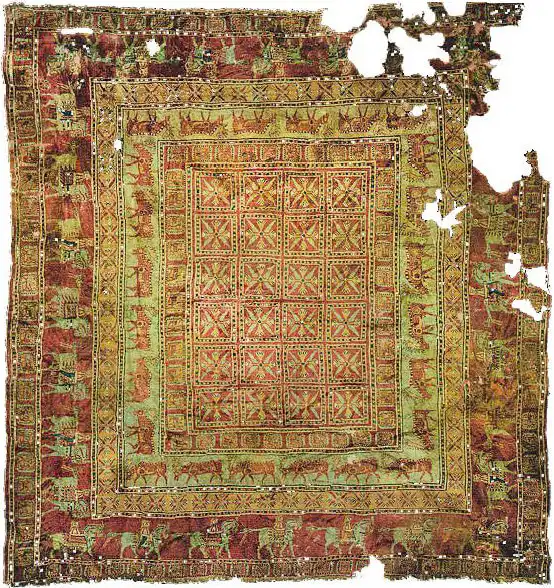
That single object tells you most of what you need to know about the long arc of antique rug history. The craft is older than nearly every other decorative art still practiced today, it emerged in Central Asia among nomadic peoples who needed portable insulation against brutal winters, and the surviving record is a tiny fraction of what was actually made. Wool decays. Fire, water, moths, and use destroy textiles at rates that simply do not affect bronze, ceramics, or stone. When a 17th-century Persian carpet appears at auction in good condition, it has survived against odds that would astonish most collectors.
The story accelerates dramatically in the 16th century under the Safavid dynasty in Persia. Shah Tahmasp and Shah Abbas the Great transformed carpet weaving from a regional craft into an imperial art form, establishing court workshops in Tabriz, Kashan, Isfahan, and Kerman that produced pieces of staggering complexity. The Ardabil Carpet, woven in 1539 to 1540 and now split between the Victoria and Albert Museum in London and the Los Angeles County Museum of Art, contains roughly 25 million knots and required years of work from a team of master weavers. Safavid court production set the technical and aesthetic standard against which all subsequent Persian weaving has been measured.
Roughly parallel developments shaped the Ottoman Empire, where the Hereke imperial workshop near Istanbul produced fine silk carpets for the sultan’s palaces, while village and town weavers across Anatolia, Ushak (Oushak), Konya, and Ladik, developed the bold geometric vocabularies that European painters from Lotto to Holbein recorded in their portraits of merchants and aristocrats. The Caucasus, sitting at the crossroads between Persia, Anatolia, and Russia, developed its own distinct tradition characterized by brilliant color, geometric stylization, and the small-scale formats that fit the homes of village weavers rather than palace floors. Turkmen tribes in Central Asia wove the deep madder-red rugs and bag faces that would later flood Western markets through the Russian Empire’s expansion. Mughal India, Chinese imperial workshops in Ningxia and Beijing, and even Egyptian Mamluk weavers all contributed distinct traditions during this period.
What Western collectors today actually encounter at auction is mostly not from these earlier centuries. The vast majority of antique rugs available on the market were woven between roughly 1850 and 1920, and there’s a specific reason for this. The late 19th century saw a collecting boom in Europe and North America driven by industrial wealth, the rise of the decorating profession, the influence of Liberty’s of London and similar tastemakers, and the World’s Fair exhibitions that introduced Persian and Ottoman art to mass Western audiences. Demand exploded. Workshops in Tabriz, Sultanabad, Kerman, and Hamadan scaled up production specifically for the export market, often financed by Western firms like Ziegler and Company, which commissioned softer palettes and larger formats designed for European and American interiors. This period also saw village and tribal weavers producing in higher volume than ever before, knowing there was a buyer in Constantinople or London willing to pay.
Many specialists quietly consider the years between roughly 1880 and 1910 the practical golden age of available antique carpets, not because the weaving was technically superior to Safavid work, but because enough survives in good condition to actually buy, the materials and dyes were still overwhelmingly natural, and the design traditions had not yet been compromised by the design committees and chemical shortcuts that came later. A well-preserved Sultanabad from 1895, a Heriz from 1900, a Kazak from 1880, these are the pieces that anchor most serious collections today.
Two events ended the era. The First World War disrupted trade routes and weaving regions across the Ottoman and Persian territories, and the introduction of chrome dyes in the 1920s, followed by the broader industrialization of the carpet trade through the 20th century, fundamentally changed what was being made. Rugs woven after roughly 1930 belong to a different commercial and material world, which is precisely why the 100-year cutoff carries the weight it does. It marks not just an arbitrary age but a real break in how the craft was practiced.
How Antique Rugs Are Made (Materials, Knots, and Dyes)
Pick up an antique rug and turn it over. The back tells you almost everything. You can see the individual knots, count them, read the foundation, spot repairs, and in many cases identify the weaving region within seconds. This is where the romance of the object meets the engineering of it, and understanding the construction is the difference between a buyer who guesses and a buyer who knows.
Every hand-knotted rug is built on a foundation of warps and wefts. The warps are the vertical threads stretched tight on the loom, running the full length of the rug from one end to the other. The wefts are horizontal threads passed between rows of knots to lock everything in place. In Persian and most Anatolian rugs, the foundation is typically cotton, which holds tension well and lies flat. Tribal and nomadic rugs from the Caucasus, Turkmenistan, and parts of Anatolia often use wool warps and wefts, which gives the finished piece a slightly more flexible, undulating handle. Silk foundations appear in the finest court-quality work, particularly Hereke, Kashan, and some Tabriz production, where weavers needed maximum tensile strength to support extremely high knot counts. Foundation material is one of the first things a specialist checks, because it narrows the origin immediately.
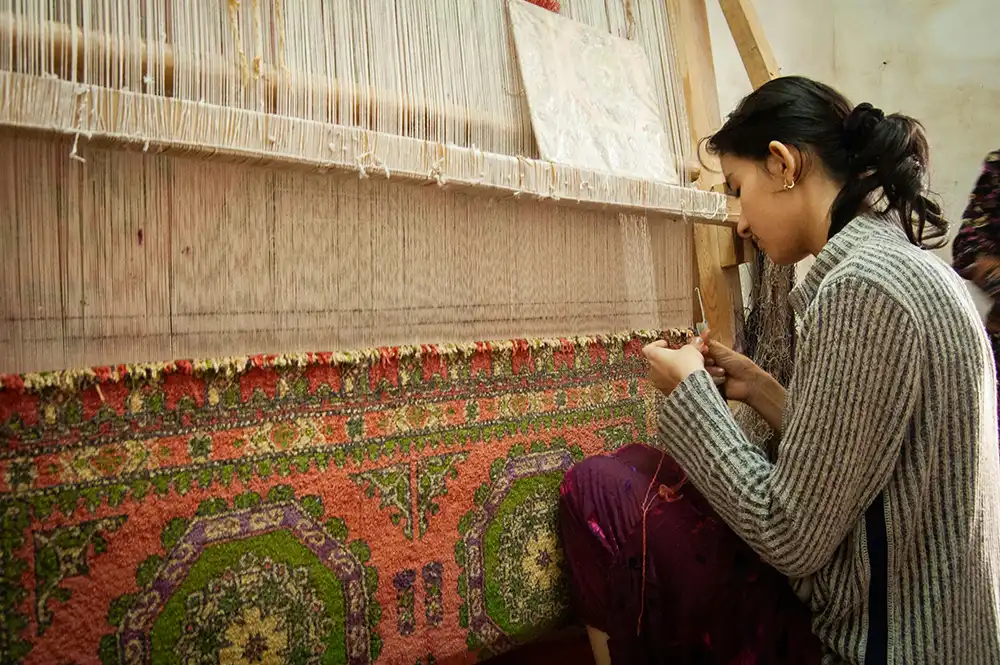
The pile, the part you actually see and touch, is almost always wool. But not all wool is the same, and this is where antique rugs decisively separate themselves from modern production. Hand-spun wool from indigenous fat-tailed sheep breeds, fed on mountain pasture and shorn at specific times of year, contains high levels of lanolin, the natural oil that makes the fiber soft, lustrous, and remarkably resistant to soiling. Antique Kashan rugs are famous for their kork wool, taken from the throat and underbelly of the lamb, which produces a pile so soft it almost feels like silk. Modern commercial wool, by contrast, is often machine-spun, chemically washed to remove lanolin, and sourced from breeds optimized for meat rather than fiber. The result is a duller, drier, scratchier surface that ages badly. When you handle a great antique rug, you’re feeling a material that essentially no longer exists at scale.
Silk appears in the highest tier of antique work. Pure silk pieces from Hereke, Kashan, Qum, and Tabriz can carry knot counts of 600 to 1,200 per square inch, sometimes higher, and were traditionally woven for palaces, presentation pieces, and the wealthiest export buyers. Silk pile catches and reflects light differently from wool, producing the characteristic shimmer that shifts as you walk around the rug.
The knots themselves come in two principal forms, and learning to recognize them is fundamental. The asymmetrical knot, also called the Persian or Senneh knot, wraps around one warp and passes loosely behind the adjacent warp, allowing finer detail and curvilinear designs. It’s standard in most Persian production: Kashan, Tabriz, Isfahan, Kerman, and Nain. The symmetrical knot, called the Turkish or Ghiordes knot, wraps around two warps in a balanced figure-eight that produces a sturdier, slightly bolder pile structure. It dominates Anatolian, Caucasian, and Kurdish weaving. Neither is superior. They produce different visual results and suit different design vocabularies. Knot count, expressed as knots per square inch (KPSI), ranges from roughly 30 to 80 in tribal and village work, 100 to 300 in solid town and city production, and upward of 500 in the finest court-quality silk pieces. Higher is not automatically better. A coarse Kazak with 50 KPSI and brilliant natural dyes will outsell a tight 200 KPSI piece with weak design and dead color every time.
The dye story is where antique rugs reveal their age most honestly. Before the 1860s, every rug on earth was colored with natural dyes drawn from plants, insects, and minerals. Madder root produced the entire range of reds, from soft salmon to deep brick. Indigo, fermented in vats, gave the blues, from pale sky to near-black navy. Walnut husks and oak galls yielded browns and blacks. Weld, vine leaves, and pomegranate rind produced yellows. Cochineal, an insect imported from the New World, gave the cooler crimson reds prized in certain Persian and Caucasian work. These dyes were prepared in small batches by hand, and no two batches were ever identical. The result is a phenomenon called abrash, the subtle horizontal striping or shifting of color across the field of a rug as the weaver exhausted one dye lot and moved to the next. Abrash is not a flaw. It is a signature of authenticity, and trained eyes look for it immediately.
Synthetic aniline dyes arrived from Germany in the 1860s, and the carpet world has been dating against that boundary ever since. Early anilines were chemically unstable, fading badly and sometimes bleeding into adjacent colors when wet, and within a generation many traditional weaving regions had partially or fully banned their use. Chrome dyes, introduced in the 1920s, were more stable and eventually displaced natural dyes for most commercial production. A specialist evaluating an antique rug looks for the depth, variation, and aging characteristics of natural dyes, the absence of telltale aniline bleed, and the overall harmony of the palette as it has mellowed over a century or more. When all three line up, you’re looking at the real thing.
The Major Weaving Regions and How to Recognize Them
The first time a new collector walks through a major rug auction, the catalog can feel like an unfamiliar language. Heriz, Hereke, Hamadan. Kazak, Kashan, Kerman. The names blur together. But each one points to a specific place, a specific weaving tradition, and a specific set of visual characteristics that, once learned, become as recognizable as the difference between a Bordeaux and a Burgundy. You don’t need to memorize hundreds of subcategories to bid intelligently. You need to know the major families and a handful of identifying traits for each.
Persian rugs dominate most antique rug auctions, and within Persia (modern Iran), each weaving center developed its own visual fingerprint. Tabriz in the northwest produced finely knotted town rugs with formal medallion designs, often in a refined palette of ivory, soft red, and indigo, and historically supplied the highest tier of the export trade. Kashan is famous for the kork wool pile mentioned earlier, central medallions on deep red or ivory grounds, and a courtly, balanced aesthetic. Heriz rugs, woven in villages near Tabriz, are instantly recognizable: bold geometric medallions, terracotta and rust-red fields, and sturdy construction that has made them favorites for high-traffic American interiors for over a century.
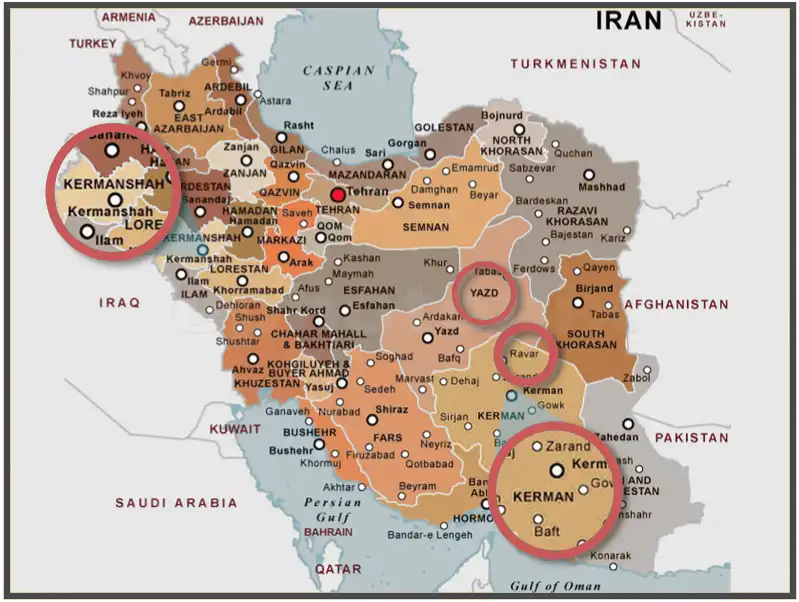
Sultanabad (the trade name for rugs from the Arak region) produced the large-scale, allover floral designs in soft, atmospheric palettes that Western decorators have prized since the late 19th century, particularly the Ziegler-commissioned pieces. Bidjar rugs, woven by Kurdish weavers in western Persia, are extraordinarily dense and heavy, sometimes called the “iron rugs of Persia,” with exceptional durability. Kerman in the southeast produced elegant, often pastel pieces with elaborate floral designs and a distinctive long, soft pile. Isfahan and Nain represent the high-knot-count refined urban tradition, often incorporating silk highlights and intricate medallion-and-corner compositions. Senneh, despite lending its name to the asymmetrical knot, actually produces rugs known for fine herati patterns and a flat, almost kilim-like handle.
Turkish rugs, from the lands of the former Ottoman Empire, fall into two broad camps. The imperial workshop tradition centered on Hereke, near Istanbul, produced silk rugs of extraordinary fineness for the sultan’s palaces, with knot counts that can exceed 1,000 per square inch. The village and tribal tradition produced Ushak (large-format carpets famous from Renaissance painting and revived in the late 19th century with softer, decorator-friendly palettes), Konya (warm, archaic geometric pieces from central Anatolia), and Oushak (the standard Western export spelling, often referring to the same late-19th-century revival production). Turkish rugs almost universally use the symmetrical knot and tend toward bolder, more architectural design vocabularies than Persian work.
Caucasian rugs come from the mountainous region between the Black and Caspian Seas, and they have their own enthusiastic collector base. Kazak rugs are the showstoppers: brilliant reds, deep blues, ivory accents, large-scale geometric medallions, and a confident, almost graphic boldness that translates beautifully into modern interiors. Shirvan pieces tend to be finer and more refined, often with all-over patterns of small repeating motifs. Kuba rugs, from the eastern Caucasus, feature dense designs and excellent wool quality. Karabagh weaving, from the southern Caucasus, sometimes shows European floral influence alongside the regional geometric vocabulary. Caucasian rugs are typically smaller in format than Persian production, which suits both the homes they were woven in and the wall-hanging market many collectors favor today.
Turkmen rugs, woven by the nomadic tribes of Central Asia, are defined by deep madder reds and a vocabulary of repeating tribal medallions called guls. Tekke rugs, with their characteristic small repeating guls in neat rows, became so closely associated with the Western image of the “Bukhara rug” that the trade name stuck despite the rugs not actually being woven in Bukhara. Yomud and Salor weaving represent other major Turkmen tribal traditions, each with its own gul forms and palette nuances. Turkmen rugs are deeply collected as ethnographic objects as much as decorative ones.
Indian rugs from the Mughal tradition and its 19th-century descendants center on Agra, Amritsar, and Lahore. Antique Agra carpets, in particular, are prized for their grand scale, refined drawing, and softer, more European-friendly palettes that suited the British colonial and American Gilded Age markets. Chinese rugs from Ningxia, Peking, and Tibetan workshops use a distinct visual vocabulary of dragons, clouds, lotus blossoms, and Buddhist symbolism, typically in sparse, open compositions on yellow, blue, or peach grounds. The construction, with its loose knot structure and characteristic carved-pile finish on later pieces, is unmistakable once you’ve seen a few.
European traditions deserve their own brief mention. Aubusson and Savonnerie, both French, produced pile and flat-woven carpets for the aristocracy and later for export. Aubusson pieces are tapestry-woven, flat, and feature elaborate Neoclassical and Rococo designs. Savonnerie carpets are pile-woven and rank among the finest European production ever made. Donegal, in Ireland, produced hand-knotted carpets in the late 19th and early 20th centuries influenced by the Arts and Crafts movement, and good antique Donegals have a small but serious collector following today.
You don’t need to recognize every weaving village on first inspection. Start with the major families: a Persian Heriz looks nothing like a Caucasian Kazak, which looks nothing like a Turkmen Tekke. Train your eye on those broad distinctions first, and the subtler ones will follow.
How to Evaluate Quality, Condition, and Authenticity
This is the section that separates collectors from buyers. Anyone with a paddle can outbid the room. The collectors who build collections that hold and grow in value are the ones who learn to read a rug before they raise their hand. Most of that reading happens in the preview room, with the rug flat on the floor or draped over a rack, in good light, with time and patience.
Start with knot density. Fold the rug back on itself so the pile parts and you can see the knots on the back. Count the knots in a one-inch horizontal span and a one-inch vertical span, then multiply. That’s your knots per square inch. A coarse tribal Kazak might come in at 60 KPSI. A solid Persian village rug runs 100 to 160. A fine Tabriz or Kashan reaches 250 to 400. Court-quality Hereke silks exceed 1,000. But knot count is only meaningful in the context of what the rug is supposed to be. A Kazak with 200 KPSI is not a better Kazak. It’s a strange Kazak. Density should match the regional tradition. When it doesn’t, something is off, either the attribution is wrong or the piece is a later reproduction trying to pass.
Next, examine the wool itself. Run your hand across the pile in both directions. Antique wool with intact lanolin feels almost cool to the touch, springs back when you press it, and has a soft luster under raking light. Dry, brittle, dull pile usually means harsh chemical washing, poor original wool, or both. Bend a corner. The pile should flex, not crackle. Look for evenness of wear. A rug worn uniformly across the field has aged honestly. A rug with one bald patch and three pristine patches has lived a hard life and probably been spot-repaired.
Check the foundation by looking at the back. The warps and wefts should be tight, intact, and consistent with the regional tradition (cotton for most Persian and Anatolian production, wool for tribal and nomadic work, silk for the highest court pieces). Cracks, breaks, and splits in the foundation are serious. They’re expensive to repair, often impossible to repair invisibly, and they progress over time. A foundation crack across a ten-inch span will eventually become a tear, and the rug’s value drops accordingly.
The selvages and end finishes tell you whether the rug is structurally complete. The selvages are the finished side edges, usually wrapped in wool or goat hair. The ends are finished with kilim bands and fringes that are extensions of the warps. Original selvages and original end finishes add significant value. Replaced selvages, while sometimes necessary and acceptable, are a deduction. Heavily reduced rugs, where damaged ends were simply cut off and rebound, lose proportion and value. Always ask: are the dimensions the rug shows me today the dimensions it had when it left the loom?
Repairs and restoration are where things get nuanced. A century-old antique rug with no repairs at all is rare and usually expensive. Most antique rugs have been touched up over their lives, and high-quality, period-appropriate restoration done with hand-spun, naturally dyed wool by a skilled restorer can preserve value beautifully. What kills value is bad repair: synthetic yarn knotted into an antique field, painted-in repairs (where someone literally inks color onto worn pile to disguise loss), reweaves that don’t match the original knot structure, and rebuilt borders that change the rug’s proportions. A good condition report will note repairs honestly. A great auction house will photograph them.
The dye check is the authentication step most beginners skip. Wet a white cotton swab with a little water and press it firmly into the pile in an inconspicuous spot. Lift it. If color transfers, the dyes are unstable, which is a red flag for either bad synthetic dyes or poor washing. Look at the back versus the front. Natural dyes tend to age more uniformly through the pile, while harsh chemical washes (used to artificially “antique” newer rugs) often produce a sharp color difference between the tips of the pile and the base of the knots. Look for abrash, the subtle horizontal color shifts discussed in the construction section. Genuine abrash is irregular and organic. Faked abrash, applied through chemical washing or painting, tends to look stripey and contrived.
Watch for the specific tricks used to age modern rugs into looking antique. Tea washing and chemical washing soften and dull colors but leave a characteristic flat, lifeless quality once you’ve trained your eye. Sun fading is sometimes faked by leaving rugs exposed to harsh light for weeks, but real century-old fade is gradual, multi-directional, and integrated with how the rug was actually used. Painted repairs show up under a magnifying glass as ink sitting on top of the fiber rather than dye penetrating it. None of these tricks survive serious examination, which is exactly why serious examination matters.
Finally, the condition report. At a reputable auction house, every antique rug lot of meaningful value should come with a written condition report, ideally with photographs, that describes the piece honestly: dimensions, knot count, materials, dyes, condition of pile, foundation, selvages, ends, and any repairs or losses. Read it before you bid. If you can’t get to the preview in person, the condition report is your eyes. Ask questions. Reputable specialists answer them. The single biggest mistake new buyers make is bidding on the photograph and the estimate rather than the condition report and the structural reality. Don’t make that mistake.
Buying, Caring For, and Living With an Antique Rug
The auction is where most serious antique rugs change hands today, and the process rewards preparation. Months before a sale, catalog previews go live online with photographs, descriptions, estimates, and condition reports. Spend time with them. Identify three or four lots that genuinely interest you, study the comparables (similar pieces that sold at recent auctions, which most houses publish), and decide what each one is worth to you before the live bidding starts. The single most disciplined habit a new buyer can develop is writing down a maximum bid in advance and not exceeding it in the heat of the room. Auction adrenaline is a real phenomenon, and it has talked many otherwise sensible collectors into paying twenty percent over their ceiling.
Preview the rugs in person whenever possible. Photographs flatten color, hide texture, and rarely communicate scale or handle. At HeritageBids previews, lots are available for inspection in the days leading up to the sale, and specialists are on hand to answer questions, discuss attribution, and walk you through condition reports. If you cannot attend in person, request additional photographs, ask for a video walkthrough, and read the condition report twice. Bid by phone, by absentee bid, or live online, whichever format suits you best.
Factor in the buyer’s premium. Every auction house adds a percentage to the hammer price that goes to the house rather than the seller, typically in the range of 20 to 28 percent depending on the firm and the lot value. A rug that hammers at $5,000 will cost you somewhere between $6,000 and $6,400 before shipping and any applicable sales tax. Build that into your maximum bid from the start. New collectors who forget the premium routinely overpay relative to their actual budget.
Shipping antique rugs requires more care than shipping most auction categories. Rugs should be rolled, never folded, and rolled with the pile facing inward to protect the surface. Larger pieces ship by freight; smaller pieces by parcel carrier with appropriate insurance. Reputable houses coordinate this for buyers, but confirm in writing that the shipper has experience with antique textiles. Insurance during transit should cover the full purchase price including the buyer’s premium.
Once the rug is home, the care fundamentals are simpler than most buyers expect. Rotate the rug 180 degrees once or twice a year so wear and sun exposure distribute evenly. Use a quality rug pad underneath, both for safety and to extend the life of the foundation. A good pad cushions every footstep and prevents the rug from sliding, which damages the foundation over time. Keep antique rugs out of direct, sustained sunlight when possible. UV exposure fades natural dyes, and while a gently sun-mellowed rug has its own beauty, intense direct sun for years will bleach color irreversibly.
Vacuum gently and correctly. The single most common mistake owners make is using a vacuum with a beater bar or rotating brush, which over time pulls fibers loose, abrades the pile, and damages the foundation. Use suction only, ideally with the brush attachment, and never vacuum the fringes (which can be torn out by the suction itself). Once or twice a year, take the rug outside, drape it pile-down over a railing, and gently sweep the back to dislodge embedded grit. Grit is a slow killer of antique rugs because it works its way into the foundation and cuts wool fibers from below as people walk on it.
Have antique rugs professionally washed every five to seven years, depending on traffic and household conditions. Find a hand-washer who specializes in antique rugs, not a commercial carpet cleaner. The right washer will use cool water, gentle soap, and proper drying methods, and a good wash will revive the wool’s luster, remove decades of dust, and often surprise the owner with how much color was hiding under the patina.
Watch for moths, especially in low-traffic rooms, under furniture, and in stored rugs. Moth larvae feed on wool and can devastate a rug in months. Cedar, lavender, and regular vacuuming all help. If you store a rug, roll it tightly, wrap it in clean cotton or muslin (never plastic, which traps moisture), and inspect it every few months.
On the financial side, insure antique rugs separately as scheduled items on your homeowner’s policy. Standard coverage rarely reflects actual replacement value at auction. Get an independent appraisal every five to seven years, since the market for antique carpets shifts and a piece appraised in 2018 may be worth meaningfully more or less today. Keep all auction invoices, condition reports, and provenance documents together. When the time comes to sell or pass the rug on, that file is what turns a nice old rug into a documented collectible.
The longer view on antique rugs as a collecting category is genuinely encouraging. Unlike many decorative arts categories that have softened over the past two decades, the best antique carpets have held value remarkably well, and certain segments (particularly fine Caucasian, early Turkmen, and pre-1900 Persian village pieces) have appreciated steadily as supply contracts. The reason is structural: nobody is making more antique rugs. Every year the surviving pool gets smaller through wear, damage, and the unrecoverable losses that come with time. Demand from collectors, designers, and a new generation of buyers who appreciate handmade objects in an age of mass production continues to grow. The pieces that are wonderful today will be more wonderful, and rarer, in twenty years.
That’s the real argument for buying antique rather than new. You are buying an object that took a year of human labor to make, that was woven from materials that no longer exist at scale, that has already survived a century of use, and that will almost certainly outlive you. Few categories in the auction world offer that combination of beauty, craft, history, and durability at the price points antique rugs still command. Start with one piece you genuinely love, learn everything you can about it, and let the collection grow from there. That’s how the great collections have always been built, and it’s how the next generation of HeritageBids collectors are building theirs now.