Bali is often introduced through its landscape: rice terraces, volcanic mountains, tropical forests and temples rising above village walls. Yet the island’s deeper identity is found not in scenery alone, but in the relationship between people, nature, ancestry and the unseen world. These connections shape daily life, religious observance, performance and, for generations, the work of Balinese painters.
The Balinese art presented in HeritageBids’ Bali: Tradition, Myth & Modern Vision auction offer many ways of entering this visual culture. Some record villagers farming, fishing, cooking or gathering at a market. Others turn to temple ceremonies, sacred dances and the eve of Nyepi. A further group draws upon the Ramayana, the Mahabharata and local narratives populated by warriors, divine beings, protective creatures and dangerous forces. Contemporary artists then carry these subjects into new territory through symbolism, abstraction, environmental reflection and personal memory.
Seen together, the works do not describe tradition as something frozen in the past. They show it being performed, questioned, remembered and renewed. Classical stories remain present, but so do family life, ecological concern and the experience of a changing Bali.
“Balinese painting often asks us to read several worlds at once. A village scene may also contain ritual, a landscape may carry spiritual meaning, and a mythical creature may represent forces that remain part of contemporary life.”
— HeritageBids Fine Art Specialist
A Painting Tradition Rooted in Place
Balinese painting developed through close relationships among temples, royal courts, workshops, villages and families. Knowledge traditionally passed from one generation to another through observation and practice. The purpose of an image was not always simply decorative. Painting could accompany religious life, preserve a narrative, transmit values or give visible form to beings and forces that could not otherwise be seen.
Kamasan painting, associated with the village of Kamasan in Klungkung, preserves a courtly visual language closely connected to wayang, or shadow-puppet theatre. Figures are identified through their faces, bodies, clothing and gestures, while episodes from Hindu epics unfold across carefully organized surfaces. The compositions often function less like a single frozen instant than a complete field of storytelling.
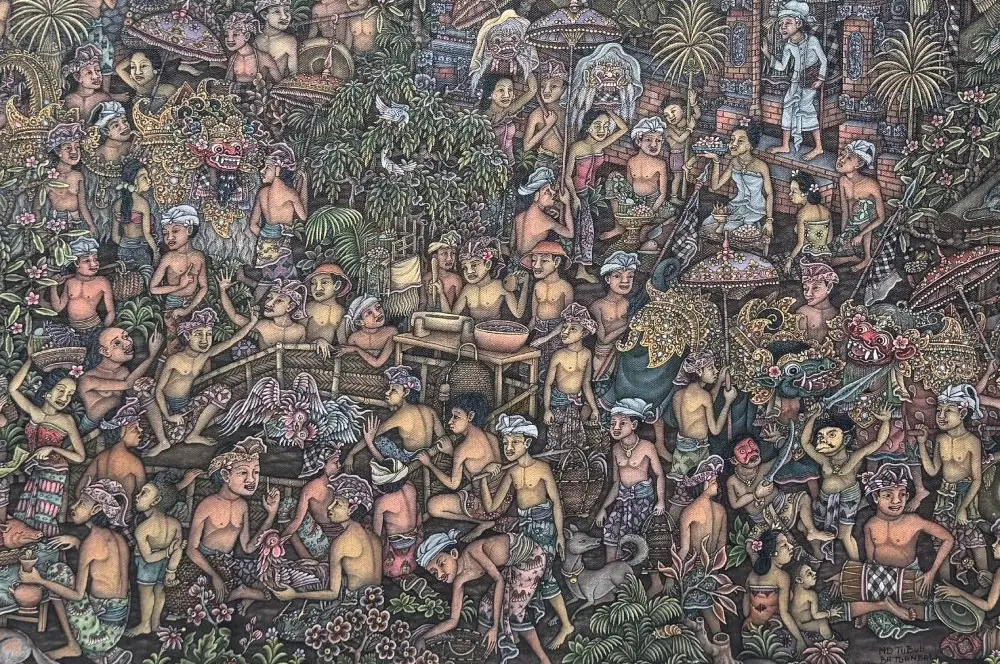
Batuan painting, named for the village south of Ubud, developed another highly recognizable language. Dense compositions, precise drawing, layered tonal work and crowded worlds reward prolonged viewing. Myth, ceremony, village labor, animals, vegetation and supernatural events can occupy the same picture. Darkness is not merely a coloristic choice: it can create depth, mystery and an atmosphere in which visible and invisible realities seem to overlap.
During the twentieth century, contact with artists from abroad and the growth of new exhibition networks encouraged Balinese painters to experiment with perspective, color, individual expression and secular subjects. The Young Artists movement associated with Arie Smit and painters from Penestanan introduced especially bright palettes and rhythmic scenes of village life. None of these developments erased older traditions. Instead, Bali’s artistic history became a conversation among inheritance, local innovation and wider modern art.
Village Life as Cultural Memory
Scenes of ordinary work are among the most revealing images in the auction. Farming, fishing, bathing, collecting water and carrying produce appear not as isolated activities, but as parts of an interdependent social world. In Batuan Villagers’ Life by I Made Tubuh, farming, fishing, trade and ceremony form a single intricate panorama. Daily Life in Bali by Pande Wayan Eka Wahyu Pratama looks back toward village life around 1980, joining human activity to the river and surrounding land.
The market scenes by Ni Wayan Sunadri Soki and an artist whose identity is still being researched present another center of communal life. Their crowded arrangements turn buying and selling into studies of movement, color and social interaction. I Wayan Nurbawa’s The Lives of Fishermen expands the idea of labor across sea and shore, with boats, nets and cultivated land appearing within one continuous environment.
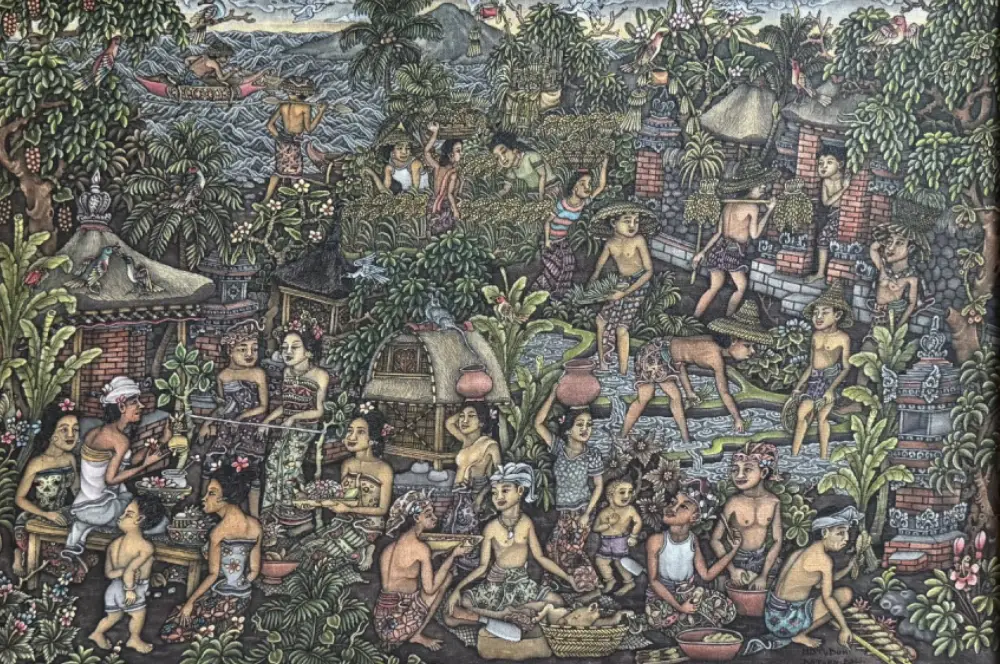
Food preparation carries cultural meaning as well. Lawar is a traditional Balinese mixture prepared in many variations and closely associated with communal work and ceremonial occasions. Pande Made Dwi Artha’s Making Lawar treats ngelawar as a lived family experience. A child playfully wearing a Barong mask links cooking to performance and shows how cultural knowledge enters childhood through participation rather than formal instruction.
Ceremony, Transition and the Balinese Calendar
In Bali, ceremony brings private life, community organization, art and religion together. Offerings, textiles, architecture, music, dance and procession transform space while marking relationships among human beings, ancestors, deities and nature. Paintings of these occasions can therefore operate as visual records, devotional reflections and complex social narratives at the same time.
Ngaben, the Balinese Hindu cremation ceremony, concerns the release of the deceased from the physical body and the continuation of the soul’s journey. The work catalogued as Cremation Ceremony, presently attributed to Ida Bagus Made pending specialist examination, compresses figures and ritual structures into a vertical field of activity. Its density expresses the public and communal dimension of a rite centered on passage and transformation.
Nyepi, Bali’s Day of Silence, is preceded by a dramatic change in atmosphere. On Pengrupukan, communities perform ritual activity and parade Ogoh-Ogoh: large, temporary effigies often representing bhuta kala, unruly or disruptive forces. Their exaggerated bodies can be comic, frightening or satirical. The noise and spectacle of the eve give way to stillness, restraint and reflection on Nyepi itself. Ogoh-Ogoh by I Made Ariana captures the energy of the procession, while Pengrupukan, attributed to I Made Djata pending authentication, presents the event through an intricately crowded Batuan composition.
The sacred Sang Hyang dances are associated with trance, protection and the relationship between community and divine presence. In Sang Hyang Dedari, traditionally performed by young female dancers, the dancers enter an altered ceremonial state. Pande Made Dwi Artha’s Sang Hyang Dedari uses brown paper and layered gauze to emphasize the uncertain boundary between the physical and spiritual worlds.
Temple festivals also gather many arts into one event. I Ketut Kenur’s The Great Ceremony at the Temple fills the surface with worshippers and ceremonial activity, allowing the eye to move through many simultaneous episodes. I Made Ariana’s Barong Dance Performance places dancers, musicians and spectators before a temple gate, stressing that sacred performance is also an act of village participation.
Barong, Rangda and the Presence of Powerful Beings
One of the most familiar figures in Balinese performance is Barong, a protective being whose appearance may combine characteristics of animals, guardian spirits and elaborate ceremonial costume. Barong is frequently described as opposing Rangda, the terrifying widow-witch associated with destructive power and the Calonarang narrative. Their encounter should not be reduced to a simple Western battle of good against evil. Balinese performance often emphasizes tension, balance and the continuing coexistence of opposing forces.
In performance, Barong is animated by dancers beneath a richly ornamented body, while Rangda commands attention through staring eyes, tusks, a long tongue and wild hair. The visual force of both figures has made them central to painting, sculpture and mask-making. In this auction, Barong appears within scenes of dance and daily life, while Prasetya Rudiantha’s Calonarang interprets the legendary witch through a turbulent gathering of figures and supernatural forms.
These beings remind us that the frightening figure in Balinese art is not necessarily presented only as an enemy. It may embody danger that must be recognized, contained or brought into balance. The image gives form to fear, disorder and invisible power, allowing the community to confront them through ritual and performance.
Kala Rahu and the Myth of the Eclipse
Kala Rahu appears in Balinese and wider Hindu mythology as a celestial being connected to eclipses. After disguising himself to drink the water of immortality, he is discovered and beheaded. Because the liquid has already touched him, his head remains alive. His pursuit and swallowing of the sun or moon explains the temporary darkness of an eclipse; the celestial body returns because Rahu has no complete body in which to hold it.
The subject appears twice in the auction, revealing how one story can generate very different images. I Wayan Rajin’s Kala Rahu concentrates on the surviving head and the myth’s dramatic supernatural charge. Pande Made Dwi Artha’s Kala Rahu shows figures watching the severed head devour the moon, shifting part of the attention toward human wonder and fear in the face of a cosmic event.
Epic Heroes, Divine Figures and Moral Choice
The Ramayana and Mahabharata have circulated in Bali through performance, recitation, sculpture and painting for centuries. Their heroes are not distant literary references. They remain active within wayang, temple imagery and popular understanding, where episodes of loyalty, desire, pride, duty and consequence can be continually retold.
Hanuman, the monkey hero of the Ramayana, embodies strength, intelligence and devotion. Pande Made Dwi Artha’s Hanuman adopts a classical Balinese visual language and incorporates script, bringing the figure into dialogue with inherited forms of sacred storytelling.
Arjuna is the great archer of the Mahabharata, but his importance extends beyond physical skill. He is repeatedly tested by questions of responsibility, discipline and right action. In Sang Arjuna, Pande Made Dwi Artha presents the warrior with a restrained classical palette that emphasizes composure and inner balance.
Bhima, another of the Pandava brothers, represents formidable physical power and resolve. The Battle of Bhima and Hidimba depicts his confrontation with the giant Hidimba in an enchanted forest. The struggle is both literal and symbolic: the hero must withstand danger while moving through exile and transformation.
Drupadi emerges from sacrificial fire in the Mahabharata and becomes essential to the destiny of the Pandavas. The Birth of Drupadi treats her miraculous arrival as an image of divine will and of blessing appearing in an unexpected form.
Sutasoma belongs to an Old Javanese Buddhist narrative that became especially important in Indonesia. Remembered for compassion and moral courage, he offers an alternative form of heroism founded on wisdom rather than conquest. In The Wise Sutasoma, a cerucuk bird accompanies him as a sign of communication and harmony between humanity and the natural world.
Gods, Goddesses and Sacred Energy
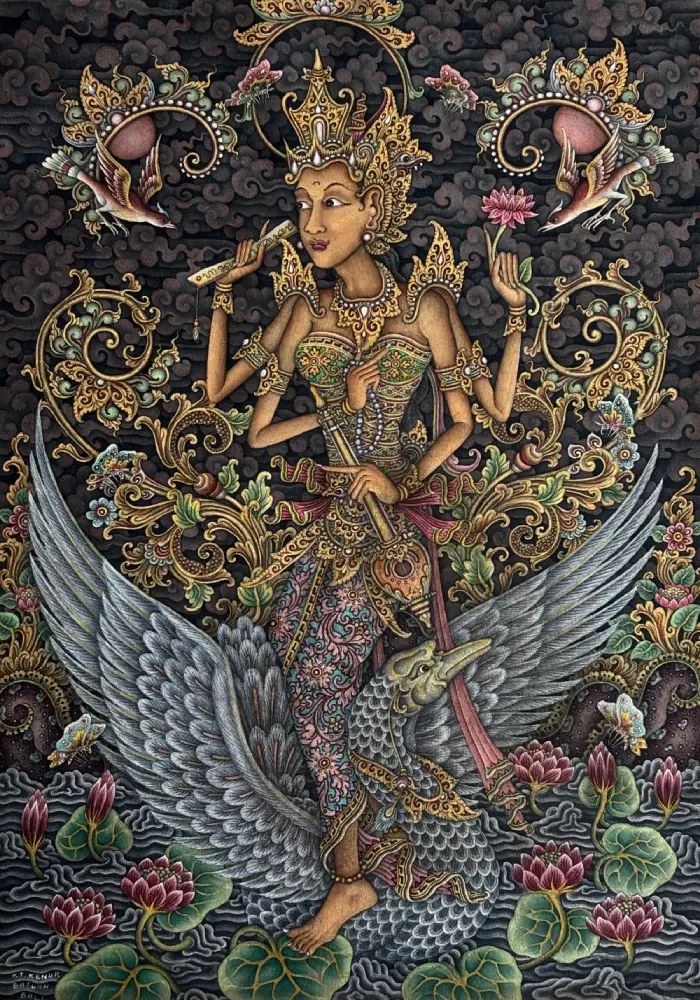
Saraswati is revered as the goddess of knowledge, learning, music and the arts. Her presence is especially meaningful in a collection devoted to painting because creativity is understood not simply as personal invention, but also as knowledge disciplined through study and practice. I Ketut Kenur’s Goddess Saraswati shows her blessing farmers, bringing intellectual and spiritual abundance into relation with the fertility of the land.
Dewi Uma, a manifestation associated with Parvati, appears in I Made Tubuh’s painting descending to earth in search of milk to heal Shiva. Tubuh builds the sacred narrative through the dense, finely worked vocabulary of Batuan painting, where natural and supernatural actors inhabit the same continuous world.
Shiva’s infinite nature is central to Siwa Lingga by I Made Cekeg. In the story, Brahma and Vishnu attempt to find the limits of an endless column of divine power. Neither reaches its beginning or end. The episode places humility before cosmic immensity and transforms the lingga into an image of the infinite.
Taksu is more difficult to translate into a single English word. It can suggest spiritual charisma, inspired presence or the power that allows a ritual or artistic performance to become fully alive. I Ketut Kenur’s Sang Hyang Taksu visualizes this energy through meditation and encounter with the divine. The painting is a reminder that technical skill alone does not explain the force of Balinese art; discipline, intention and spiritual presence also matter.
Mother Earth and a Changing Bali
Ibu Pertiwi, or Mother Earth, is a powerful figure through whom artists can consider fertility, protection and responsibility toward the environment. Pande Made Dwi Artha’s two works on the subject move between reverence and warning. Ibu Pertiwi (Flora and Fauna) surrounds a central female figure with plants, animals and a moon-like sphere, presenting life as an interdependent system. Ibu Pertiwi places Mother Earth between sacred inheritance and modern expansion, asking whether development can coexist with ecological balance.
Landscape painting raises related questions. Agung Dewi Monalisa’s terraced fields and tropical vegetation do not merely offer attractive views. They depict land shaped by cultivation, weather, labor and memory. Her atmospheric approach reflects both her family background among traditional Balinese painters and her formal study of fine art.
Contemporary Balinese art does not need to abandon tradition in order to address the present. It can borrow the density of Batuan, the silhouettes of wayang or the symbolic force of myth while speaking about environmental pressure, emotional conflict and individual experience. Prasetya Rudiantha’s diptych Dichotomy of Passion and Grace, for example, reduces the image to confronting red and blue eye-like forms. Fire and water, passion and calm become paired forces rather than mutually exclusive choices.
Pande Made Dwi Artha
Pande Made Dwi Artha was born and raised in Banjar Pekandelan in Batuan Village. He learned traditional Batuan painting directly from his father, I Ketut Kenur, developing his practice through observation, repetition and years of working beside him rather than through a formal academy. He describes patience, discipline, feeling and meaning as inseparable from technique.
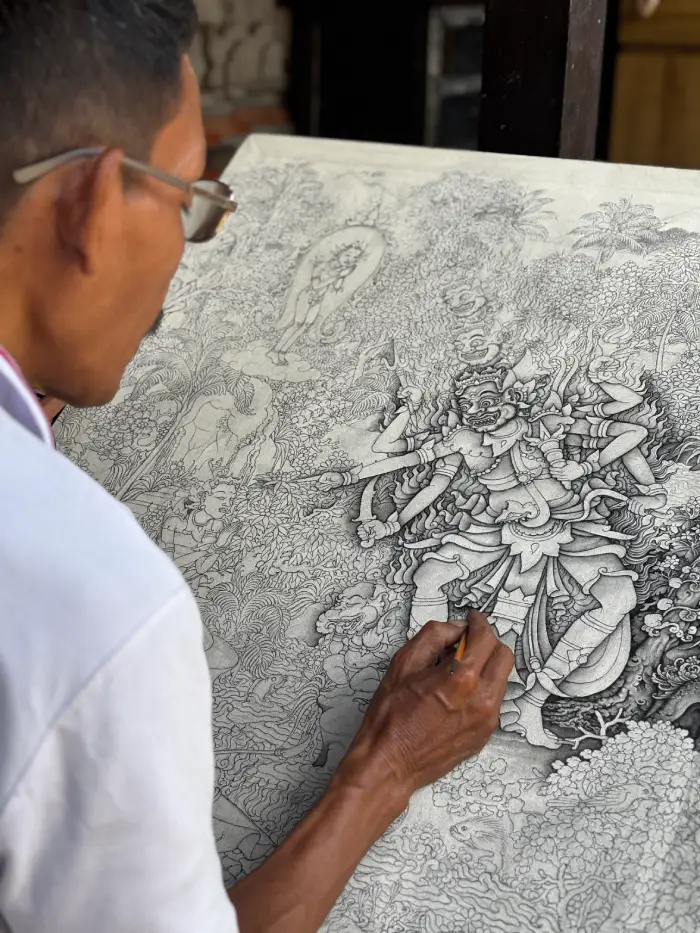
After participating in numerous group exhibitions in Batuan, Ubud and elsewhere in Bali, he held his first solo exhibition, Urip Awakening, in 2017. The exhibition considered self-awareness and the spiritual dimension of human existence. His second solo exhibition, Define Us, was held at Neka Art Museum in Ubud in 2018 and explored the individual’s relationship with nature, other people and the divine.
His fourteen works in the auction demonstrate the breadth of his traditional-contemporary practice. Mythological subjects include Sang Arjuna, Hanuman, The Wise Sutasoma, The Battle of Bhima and Hidimba, The Birth of Drupadi, Rajapala and Kala Rahu. Ceremony and communal life appear in Making Lawar and Sang Hyang Dedari, while the two Ibu Pertiwi compositions address environmental balance. Tinker Bell, The Christmas Kayon and The Enchanting Motion show his willingness to carry Batuan’s visual language into personal and cross-cultural territory.
“I see the traditional Batuan style as both a cultural inheritance and a living language—one that can continue to evolve while maintaining its roots.”
— Pande Made Dwi Artha
I Made Arya Palguna
Born in Ubud in 1976, I Made Arya Palguna first learned painting from his father, I Ketut Sudana. He later studied visual art at the Indonesian Institute of the Arts in Yogyakarta, graduating in 1996. His practice extends beyond painting into sculpture, installation, performance and murals, and his work has been exhibited in Indonesia and internationally.
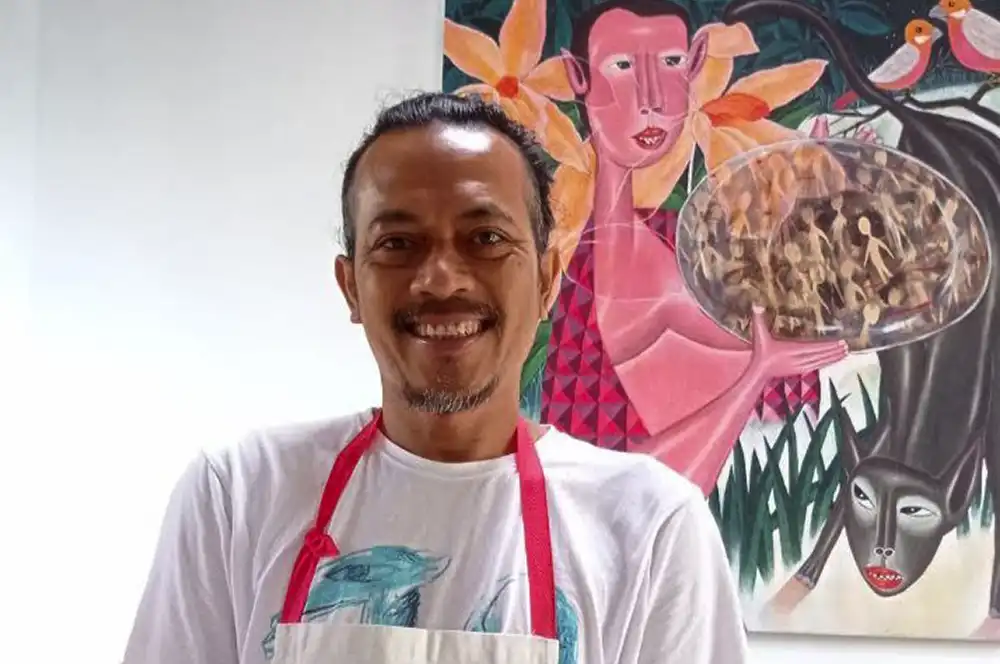
Palguna’s simplified figures, flattened spaces and vivid colors create images that are immediately approachable but psychologically open. The three works in the auction—Life Has to Be Strong, Our Root and Teaching—move among perseverance, family connection and the transmission of knowledge. They show an artist who treats Balinese identity as an active position from which to engage contemporary experience.
Prasetya Rudiantha (MNDI.ART)
Prasetya Rudiantha, working under the name MNDI.ART, is a contemporary Balinese painter whose works combine mythological imagery, ritual subjects and personal symbolism. His compositions retain an interest in detailed narrative and supernatural presence while using strong color and, at times, radically simplified forms.
Calonarang draws upon the legendary witch and the visual atmosphere of traditional Ubud painting. Reckoning of the Soul interprets karma phala through a demonic face and suffering souls, making consequence unavoidable and monumental. Spiritual Cleansing turns to purification and divine wisdom. The diptych Dichotomy of Passion and Grace moves toward abstraction, balancing red and blue, heat and calm, within a single relational work.
I Made Tubuh
I Made Tubuh is a senior painter associated with Batuan and its tradition of densely organized, carefully detailed narrative painting. His works have circulated internationally and appear regularly in the secondary market. Rather than isolating one central actor, Tubuh often allows many figures, animals, buildings and activities to share the pictorial field.
The three works offered here reveal the range of that approach. Batuan Villagers’ Life is a broad social panorama; Dewi Uma applies Batuan’s intricate vocabulary to sacred narrative; and The Rites of Life joins dance, procession, temple ritual and community activity in a richly populated vision of Balinese culture.
I Ketut Soki
I Ketut Soki (1946–2022) was one of the earliest young painters taught by the Dutch-born artist Arie Smit in Penestanan and became a foundational figure of the Young Artists movement. The group became known for brilliant color, decorative rhythm and animated scenes of Balinese life. Soki’s paintings helped establish a visual language that was modern, accessible and unmistakably connected to the island.
Rajapala brings a legendary encounter between a mortal hunter and a celestial maiden into a radiant narrative setting. Bali Island expands the artist’s vision to the scale of the entire island, filling it with temples, villages, water and ceremonial life. Together, the paintings demonstrate the brilliant color, decorative rhythm and narrative abundance associated with Soki’s art.
I Ketut Kenur
Born in 1969, I Ketut Kenur is a traditional Batuan painter and the father and first teacher of Pande Made Dwi Artha. His role represents the family-based transmission through which Balinese painting has often survived and evolved: technique is learned alongside patience, cultural knowledge and an understanding of the stories being represented.
His three works in the sale address complementary aspects of sacred life. Goddess Saraswati joins knowledge and artistic power to agricultural abundance. Sang Hyang Taksu considers inspired spiritual presence, while The Great Ceremony at the Temple brings devotion and collective participation together in an expansive ritual scene.
I Made Ariana
I Made Ariana is represented by four works centered on performance, ceremony and village participation. His paintings use broad landscapes and densely gathered figures to place cultural events within the environment of the community rather than separating performers from daily life.
Shadow Puppet Performance presents wayang as a social gathering as well as a form of inherited storytelling. Ogoh-Ogoh records the public energy of the procession before Nyepi. Barong Dance Performance unites dancers, musicians, spectators and temple architecture, while Daily Life in Bali uses a restrained monochrome palette to emphasize the rhythms and structures of village life.
Agung Dewi Monalisa
Agung Dewi Monalisa is from Kapal in Badung, Bali. Raised in a family environment that included traditional Balinese painters, she later studied fine art at IKIP PGRI. Her work focuses particularly on landscape, and she identifies Walter Spies as an important artistic reference.
The two landscapes in the auction show terraced rice fields unfolding through dense tropical growth beneath luminous skies. Their atmosphere connects cultivated land to memory and artistic inheritance, presenting nature as both a physical environment and a source of cultural identity.
I Wayan Rajin
I Wayan Rajin, whose name is also encountered as Wayan Radjin, was a Batuan painter and a member of the artistic lineage associated with I Made Djata. His work belongs to a tradition in which detailed drawing, supernatural narrative and close observation of Balinese life reinforce one another.
The auction’s Kala Rahu centers on the immortal severed head associated with the eclipse myth. The subject is particularly suited to Batuan painting, where cosmic disorder can be described through minute detail and dramatic compression.
I Made Cekeg
I Made Cekeg is represented by two narrative paintings derived from Balinese history and Hindu cosmology. His work has appeared in the secondary market, although published biographical information remains limited; the paintings themselves therefore provide the most direct introduction to his practice.
Kebo Iwa and Gajah Mada revisits the confrontation linked to Majapahit’s expansion into Bali, opposing loyalty to political ambition. Siwa Lingga moves from history to the cosmic, presenting Brahma and Vishnu’s unsuccessful attempt to measure Shiva’s infinite manifestation.
Ni Wayan Sunadri Soki
Ni Wayan Sunadri Soki is represented by Market, a compact but densely populated scene of residents buying food and daily necessities. Bright architecture and vegetation frame the figures, transforming commerce into an image of community and making ordinary exchange the subject of an animated visual narrative.
I Wayan Nurbawa
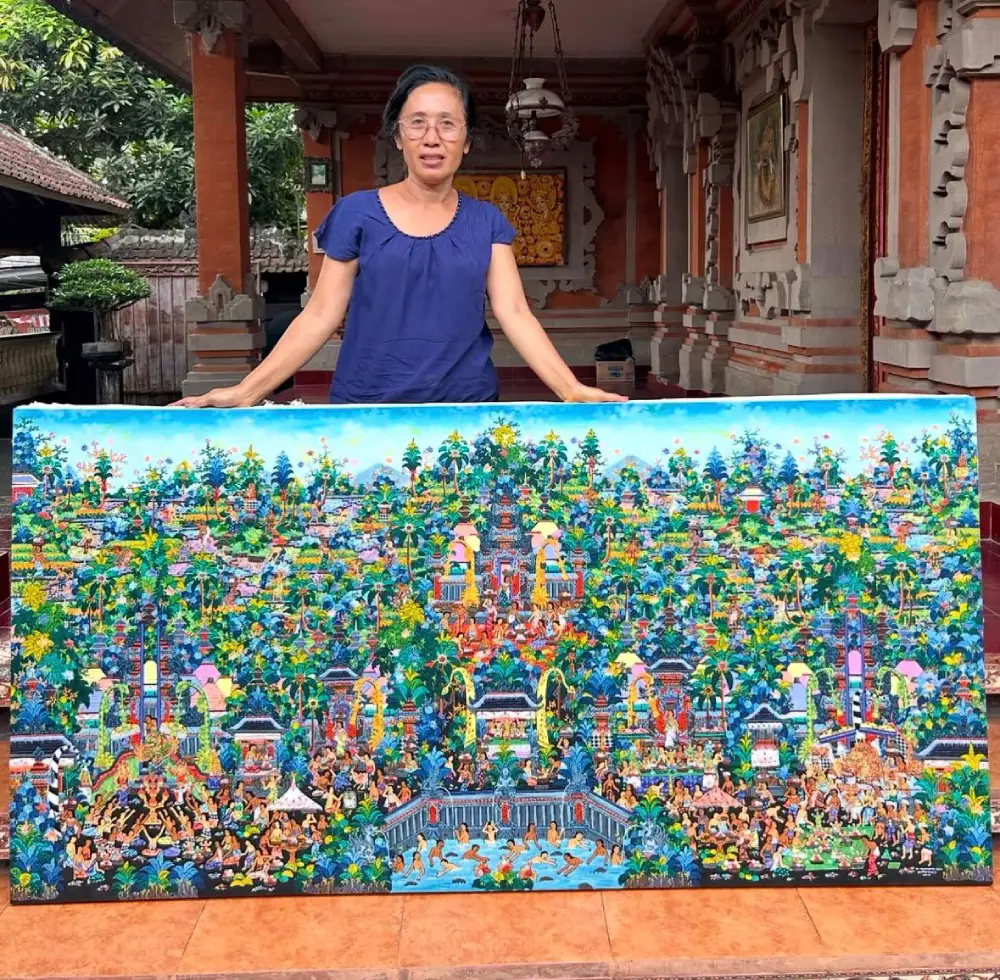
I Wayan Nurbawa’s The Lives of Fishermen presents work at sea and on land as interconnected parts of coastal existence. Painted in ink and acrylic on canvas, the large composition combines fishermen navigating waves and casting nets with agricultural activity along the shore.
Pande Wayan Eka Wahyu Pratama
Pande Wayan Eka Wahyu Pratama is represented by Daily Life in Bali, a large acrylic painting that looks toward village life around 1980. Plowing, bathing, collecting water, tending animals and fishing unfold within the same landscape. The work presents memory not through a single anecdote, but through the repeated activities that bind a community to its environment.
I Made Nyana
I Made Nyana is represented by the monumental The War of Bali (Puputan Klungkung). The painting depicts the final resistance associated with Klungkung and uses a broad field of combatants to communicate the scale and intensity of the conflict.
Attributed to I Made Djata
I Made Djata (1921–1996) belongs to the history of twentieth-century Batuan painting and is associated with a family lineage that includes later painters. The work in this auction, Pengrupukan, has been presented with a family attribution and depicts the ritual activity preceding Nyepi.
The painting is presented as Attributed to I Made Djata, reflecting the distinction between a work connected to an artist through family history and one supported by fully established authorship. Its densely arranged figures and ceremonial subject nevertheless offer a compelling encounter with the Batuan tradition.
Attributed to Ida Bagus Made
The name Ida Bagus Made is associated with more than one Balinese artist, making precise identification especially important. The auction’s Cremation Ceremony is therefore presented as Attributed to Ida Bagus Made. Its crowded Ngaben scene can be appreciated as a compelling image of ceremony while preserving a careful distinction between subject and established authorship.
Artist Not Yet Identified
Two colorful village paintings—Harvest and Market—are presented without confirmed artist names. Both contribute to the auction’s account of agriculture, trade and community. Their inclusion also recognizes that an artwork can offer cultural and visual interest even when its authorship has not been established.
Collecting Balinese Painting with Context
Balinese paintings reward both immediate looking and patient research. A collector may first respond to color, density, movement or the intensity of a supernatural figure. Greater knowledge then opens further layers: the difference between Batuan and Young Artists approaches, the identity of a wayang character, the sequence of a ceremony or the relationship between an artist and a family workshop.
Condition, medium, dimensions, signature and provenance remain essential auction information. They are especially important when a work is attributed to a historic artist or when similar names appear across generations. Cultural interpretation should complement this object-based research, not replace it.
Bali: Tradition, Myth & Modern Vision brings together forty-six works ranging from intimate works on paper to large, densely populated canvases. Across myth, landscape, family memory and ceremony, the collection presents Balinese art as an active language—one capable of preserving inherited knowledge while responding to contemporary life.
Shipping notice: The paintings will be shipped directly from Bali, Indonesia. Buyers should review the shipping terms for each lot before bidding.