Cartier History: A Parisian Workshop in 1847
The story of Cartier begins in a city on the edge of revolution. In 1847, Paris was a powder keg of political tension. Within a year, barricades would rise across the streets, the Second Republic would topple the July Monarchy, and France would once again find itself remaking its government in blood and ink. It was hardly the moment a sensible young man would choose to open a jewelry workshop. Louis-François Cartier did it anyway.
He was twenty-eight years old, the son of a metalworker and a laundress, with no family fortune behind him and no royal patron in front of him. What he had was an apprenticeship under a master jeweler named Adolphe Picard, and when Picard decided to step away from his small workshop at 29 Rue Montorgueil, Louis-François took it over. The shop was modest. The signage was new. The name above the door was Cartier.
The first years tested him. France lurched through revolution, economic collapse, a coup d’état by Louis-Napoléon, and the slow recovery that followed. Selling diamonds in a city where bread was scarce required a particular kind of conviction. Yet Louis-François had instincts that separated him from the dozens of other Parisian jewelers competing for the same shrinking clientele. He understood that fine jewelry was not really a transaction. It was a relationship. He took the time to know his clients, to design for their lives rather than his catalog, and to build a reputation one careful introduction at a time.
The first breakthrough arrived in 1856. Princess Mathilde, cousin of the future Emperor Napoleon III and one of the most influential figures in French high society, walked into the shop and placed an order. A single royal client in nineteenth-century Paris was rarely a single client for long. Word traveled through the salons of the Tuileries, and within a few years, Empress Eugénie herself had become a patron. The young workshop on Rue Montorgueil was no longer competing for attention. It was being sought out.
By 1853, Cartier had moved to a more prestigious address on Rue Neuve-des-Petits-Champs. By 1859, the year Louis-François opened his first dedicated boutique, the maison was firmly established in the world that mattered. In 1874, he handed the business to his only son, Alfred. The shop he passed down was no longer a workshop. It was the foundation of a dynasty.
The Three Brothers and the Golden Age
Alfred Cartier ran the family business with discipline and ambition through the late nineteenth century, but the transformation of Cartier from a successful Parisian jeweler into a global symbol of luxury belongs to his three sons. Louis, Pierre, and Jacques inherited a respected name in the 1890s. By the time they finished their work, they had built one of the most recognized brands in the world.
The first decisive move came in 1899, when Louis Cartier relocated the Paris flagship to 13 Rue de la Paix. The address mattered. Rue de la Paix was the most prestigious commercial street in Paris, home to the leading fashion houses, the great couturiers, and the clientele who moved between them. Placing Cartier there was a declaration. The maison was no longer one jeweler among many. It was a destination.
Then came the division of the world. The three brothers, working in unusual harmony for a family business of that era, agreed to split the globe between them. Louis stayed in Paris and took the role of creative director, shaping the design language that would define the maison for the next century. Jacques moved to London in 1902 and opened the New Bond Street boutique, cultivating the British royal family and the aristocracy of the Empire. Pierre crossed the Atlantic to New York in 1909 and set about conquering America.
Pierre’s most famous acquisition still stands at 653 Fifth Avenue. In 1917, he wanted the Italian Renaissance mansion owned by financier Morton F. Plant. Plant’s wife, Maisie, had recently developed a fascination with a particular double-strand natural pearl necklace in Cartier’s inventory. The story has been told many times because it is too good to abbreviate. Pierre traded the necklace, valued at roughly one million dollars at the time, plus one hundred dollars in cash, for the mansion. The building has been the New York Cartier flagship ever since.
While his brothers built territory, Louis built the design vocabulary. His most important contribution was technical. In the early 1900s, he pioneered the use of platinum in fine jewelry, replacing the heavier yellow and white gold settings that had defined nineteenth-century jewelry. Platinum was strong enough to hold stones with almost invisible prongs, which meant diamonds could appear to float in the light rather than sit in a metal cradle. The aesthetic shift was immediate. Cartier pieces from this period have a delicacy and luminosity that competitors could not match, and the technique became the foundation of Art Deco jewelry design.
The royal endorsements followed in waves. King Edward VII of England gave Cartier the title that the maison still cites today: “Jeweller of Kings, King of Jewellers.” At his 1911 coronation, nineteen of the tiaras worn by attending royalty were Cartier creations. The brothers eventually held royal warrants from the courts of England, Spain, Portugal, Russia, Siam, Greece, Serbia, Belgium, Romania, Egypt, Albania, Monaco, and the House of Orléans. No jeweler before or since has accumulated that kind of reach across European royalty in a single generation.
The Signature Creations That Defined the House
A jewelry house can last a long time on royal patronage alone. What separates Cartier from every other luxury maison of its era is that it also produced a series of designs that escaped the salon and entered the broader culture. The pieces below are not just bestsellers. They are the templates that the rest of the industry has been borrowing from for a century.
The Santos (1904)
Louis Cartier was friends with the Brazilian aviation pioneer Alberto Santos-Dumont, who complained one evening that fumbling for a pocket watch while flying was impractical and occasionally dangerous. Louis went back to the workshop and designed a square-cased wristwatch with exposed screws on the bezel, built specifically for the wrist rather than adapted from a pocket watch. The Santos debuted in 1904 and became publicly available in 1911. It was one of the first purpose-built men’s wristwatches in the world and the design that effectively launched the entire category.
The Tank (1917)
Louis Cartier designed the Tank in the middle of the First World War, taking inspiration from the bird’s-eye view of the Renault FT-17 tanks then rolling across the Western Front. The two vertical brancards of the watch case echo the treads. The dial sits between them like the cockpit. The first production run in 1919 produced only six watches. Within a generation, the Tank had become the most recognizable rectangular watch in the world. Andy Warhol wore one and famously said, “I don’t wear a Tank watch to tell the time. Actually, I never even wind it. I wear a Tank because it is the watch to wear.” Jackie Kennedy wore one. Princess Diana wore the Tank Française. The design has been in continuous production for more than a century.
The Panther (1914)
The panther first appeared in 1914 on an invitation card illustrated by George Barbier, depicting a woman in a Paul Poiret gown with a black panther at her feet. That same year, Cartier produced a wristwatch with onyx-and-diamond spots evoking the animal’s coat. The motif became the maison’s emblem under the direction of Jeanne Toussaint, who joined the design studio and was nicknamed La Panthère by Louis Cartier himself. In the 1940s, Toussaint pushed the panther into three dimensions, creating fully sculpted feline brooches and bracelets that the Duchess of Windsor would collect by the dozen. The panther remains the single most recognizable animal motif in fine jewelry.
The Trinity (1924)
The poet and filmmaker Jean Cocteau commissioned Louis Cartier in 1924 to create a ring with three interlocking bands, one in yellow gold, one in white gold, and one in rose gold. The three colors were said to represent love, fidelity, and friendship, the three relationships Cocteau believed defined a complete life. The Trinity was radical for its moment because it was the first major piece from a luxury jeweler made entirely of metal, with no central stone. A century later, the design is still produced almost unchanged. In 2024, Cartier marked its hundredth anniversary with a square-shaped variation.
The Love Bracelet (1969)
The Italian designer Aldo Cipullo joined Cartier New York in the late 1960s with a brief to create something for the Peace and Love generation. His answer was a bangle that locked around the wearer’s wrist with a small screwdriver and could not be removed without the partner’s help. The Love bracelet was launched in 1969 and became an instant cultural artifact. Elizabeth Taylor wore one. Sophia Loren wore one. The bracelet has been searched online more than six hundred thousand times a month for years now, and the screwdriver mechanism is still the same.
Juste un Clou (1971) and the Panthère Watch (1983)
Cipullo followed the Love bracelet with Juste un Clou in 1971, transforming a humble nail into a precious unisex bracelet. The design was ahead of its time and quietly disappeared from the catalog before Cartier relaunched it in 2012 to enormous success. The Panthère de Cartier watch arrived in 1983 as a wristwatch that doubled as high jewelry, with a brick-pattern link bracelet that moved like the animal it was named for. It became the defining women’s luxury watch of the 1980s and has returned with renewed prominence in the current decade.
Cartier and the Twentieth Century’s Most Famous Wrists
A piece of Cartier rarely sits quietly in a vault. The maison has spent more than a century outfitting the women and men whose names define the cultural memory of the modern era, and each piece carries a story that lifts it well beyond its weight in gold and platinum. For collectors, this is not an incidental detail. Provenance is one of the few elements of value that cannot be replicated, restored, or refinished. A Cartier piece worn by the right hand is worth a different kind of money entirely.
Few clients shaped the Cartier panther mythology more than Wallis Simpson, the Duchess of Windsor. Beginning in the late 1940s, she and the Duke commissioned a private menagerie of feline pieces from Jeanne Toussaint’s studio. The 1949 panther brooch perched atop a 152.35-carat Kashmir sapphire is among the most photographed jewels of the twentieth century. The 1952 articulated panther bracelet in onyx and diamonds went on to sell at Sotheby’s London in 2010 for more than seven million pounds, then a world record for a bracelet at auction.
The maharajas of India were equally important patrons. Maharaja Bhupinder Singh of Patiala arrived at Cartier in 1925 with six iron-bound trunks of his royal jewels and a commission that became legend. The resulting Patiala Necklace incorporated 2,930 diamonds, including the seventh largest in the world, and remains one of the most ambitious commissions in the maison’s history. The collaboration helped inspire the Tutti Frutti style, Cartier’s vibrant Mughal-influenced jewelry combining carved emeralds, rubies, and sapphires that has been a collector favorite ever since.
Grace Kelly received her engagement ring from Prince Rainier III of Monaco in 1956, a 10.48-carat emerald-cut diamond from Cartier that she wore in her final film, High Society, before retiring from Hollywood. The ring is now held by the Palais Princier in Monaco. Jackie Kennedy received her Cartier Tank in 1962, a gift from her brother-in-law Stanislaw Radziwill, and wore it almost daily for the next thirty years. Christie’s sold the watch in 2017 for $379,500 to Kim Kardashian, who described it as the most meaningful piece in her collection.
Elizabeth Taylor was perhaps Cartier’s most devoted ambassador of the second half of the twentieth century. In 1969, Richard Burton paid $37,000 at auction for La Peregrina, a pear-shaped natural pearl with a five-hundred-year history that had once belonged to Mary I of England and the Spanish Habsburgs. He gave it to Taylor, who took it to Cartier to be reset into a ruby and diamond necklace of her own design. When Christie’s auctioned the necklace in 2011 after her death, it sold for $11.8 million.
The list continues. Princess Diana wore a Tank Française almost daily. Andy Warhol’s Tank was sold from his estate at Sotheby’s. Bella Hadid, Rihanna, and a generation of contemporary tastemakers wear the same Panthère bracelets and Crash watches their grandmothers might have owned. The Cartier provenance chain is one of the few in luxury that has remained unbroken across more than five generations of public life, and that continuity is precisely what the auction market continues to reward.
Cartier at Auction Today
The Cartier secondary market has never been stronger than it is right now. Vintage and signed pieces are setting records across every major auction house, and the demand has been pulled forward by a generation of younger collectors who view Cartier not just as jewelry but as the most reliable design archive in the luxury world. The numbers tell the story better than any catalog copy could.
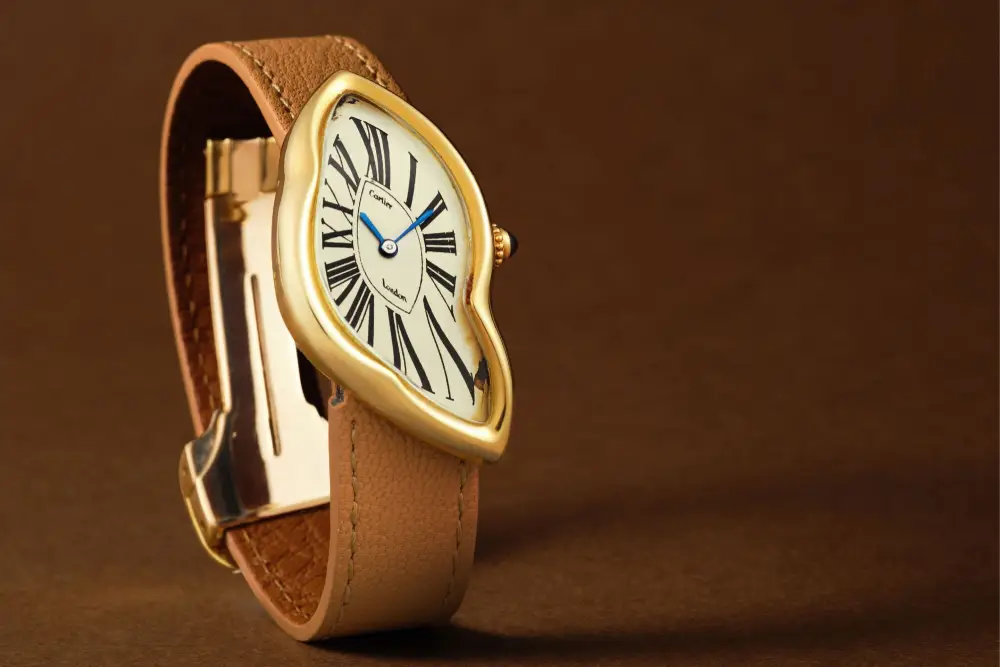
In April 2026, Sotheby’s Hong Kong presented The Shapes of Cartier, an eighty-two-piece grouping that has been called the finest vintage Cartier collection ever assembled for public sale. The total realized was $52.9 million, the highest figure for a watch auction in Asian history, with a perfect 100 percent sell-through rate. The headline lot was a 1987 Cartier London Crash in yellow gold, one of only three believed to have been produced that year. It hammered down at approximately $1.99 million after a nine-minute bidding war, making it the most valuable Cartier wristwatch ever sold at auction. The same sale set new records for the London Tank J.J.C. Allongée and the London Tank Normale.
The fine jewelry side has been generating headlines for even longer. In 2014, the Hutton-Mdivani Jadeite Necklace by Cartier sold for $27.4 million at Sotheby’s Hong Kong, more than double its high estimate, after an eighteen-minute bidding contest. The buyer was Cartier itself, which acquired the piece for its own historic collection. In 2016, the Sky Blue Diamond, an 8.01-carat fancy vivid blue diamond set in a Cartier ring, sold for $19.5 million at Sotheby’s. The 25.59-carat Sunrise Ruby, mounted by Cartier in a ring with diamonds, sold for $30.3 million at Sotheby’s Geneva in 2015, setting a world record for any ruby and any colored gemstone at the time.
What drives these results is not simply the Cartier name. It is the combination of factors that experienced collectors weigh on every lot. Period of production matters significantly. Early twentieth-century Paris-made pieces and London Bond Street workshop pieces from the 1960s and 1970s consistently outperform later Geneva production. Original components are critical, including the box, the certificate, and unaltered movements and settings. Provenance can transform a piece’s value entirely, as the Jackie Kennedy and Elizabeth Taylor sales demonstrate. Condition rewards patience. Cartier pieces with original finishes, untouched dials, and unpolished cases command meaningful premiums over restored equivalents.
Within the watch category, the vintage Tank remains the entry point for serious collectors. Tank Normales, Cintrées, and Louis Cartier models from the 1920s through the 1970s regularly trade between $15,000 and $200,000, with rare configurations exceeding that range. The Crash sits at the top of the market and has been the watch most aggressively chased by new collectors in the last five years. Within jewelry, named panther pieces, Tutti Frutti, and early Art Deco platinum work form the core of the blue chip market.
For buyers entering the Cartier market through auction, the most important practice is documentation. A Cartier piece without papers, archive confirmation, or a credible chain of ownership is not the same asset as one with full provenance, even if the two appear identical on the surface. HeritageBids approaches every Cartier consignment with this principle as the foundation. Authentication, condition reporting, and provenance research are not optional services. They are the entire basis on which a Cartier lot earns the right to be offered to collectors.
Why Collectors Build Around Cartier
Most luxury brands have a peak decade. There is a moment when the design was at its sharpest, the craftsmanship was at its most uncompromised, and the cultural relevance was at its highest. Collectors chase that decade and accept that everything before or after is supporting material. Cartier is one of the very few names in the entire luxury market that resists this pattern. The Tank from 1919 holds its own against the Tank from 2026. The Trinity ring designed for Jean Cocteau looks current on a wrist today. The panther brooches that Jeanne Toussaint sculpted for the Duchess of Windsor sit comfortably next to the high jewelry pieces leaving the Place Vendôme workshop this year. This continuity is the foundation of the collector’s case for Cartier.
Part of the reason is design philosophy. Louis Cartier insisted that the maison should never imitate, and the four principles he passed down to the design studio still govern every collection: purity of line, accuracy of shape, precision of proportions, and precious details. These are not stylistic choices. They are constraints, and constraints are what give Cartier pieces their longevity. The Tank does not look like 1917 because it was never trying to look like 1917 in the first place. It was trying to look correct, which is a much harder and more durable target.
Part of the reason is restraint. Cartier has never flooded the market the way some of its peers have. Vintage production from the Paris workshop before the Second World War is genuinely scarce. The London Bond Street workshop, which operated from 1909 until the mid-1970s and produced some of the most experimental Cartier designs ever made, including the original Crash, closed long enough ago that supply is fixed. The Richemont Group’s acquisition of Cartier in 1988 stabilized the modern business without diluting the archive, and the maison continues to operate the way the three brothers operated it, with the long view in mind.
For new collectors, Cartier is also one of the most forgiving entry points in the entire luxury secondary market. A buyer can begin with a modern Trinity ring or a recent Tank Must and own a piece that genuinely belongs to the same design lineage as the multimillion-dollar lots crossing the auction block in Hong Kong and Geneva. As experience builds, the natural progression toward vintage Paris and London production becomes a deepening of the same collection rather than a pivot away from it. Few brands offer that kind of continuous staircase.
The auction market reflects all of this. Cartier holds its value through downturns better than almost any comparable maison, the vintage references continue to appreciate at rates that outpace most asset classes, and the documented pieces with strong provenance behave less like jewelry and more like blue chip art. The collector who builds carefully around Cartier is building around design history, scarcity, and an unbroken chain of cultural relevance that began in a small Parisian workshop in 1847 and has not been interrupted since.
At HeritageBids, every Cartier piece we offer is researched, authenticated, and presented with the provenance and condition documentation that this kind of collecting requires. The maison’s history is not a marketing story. It is a verified inheritance, and the lots that pass through our auctions are treated as the cultural objects they are.